
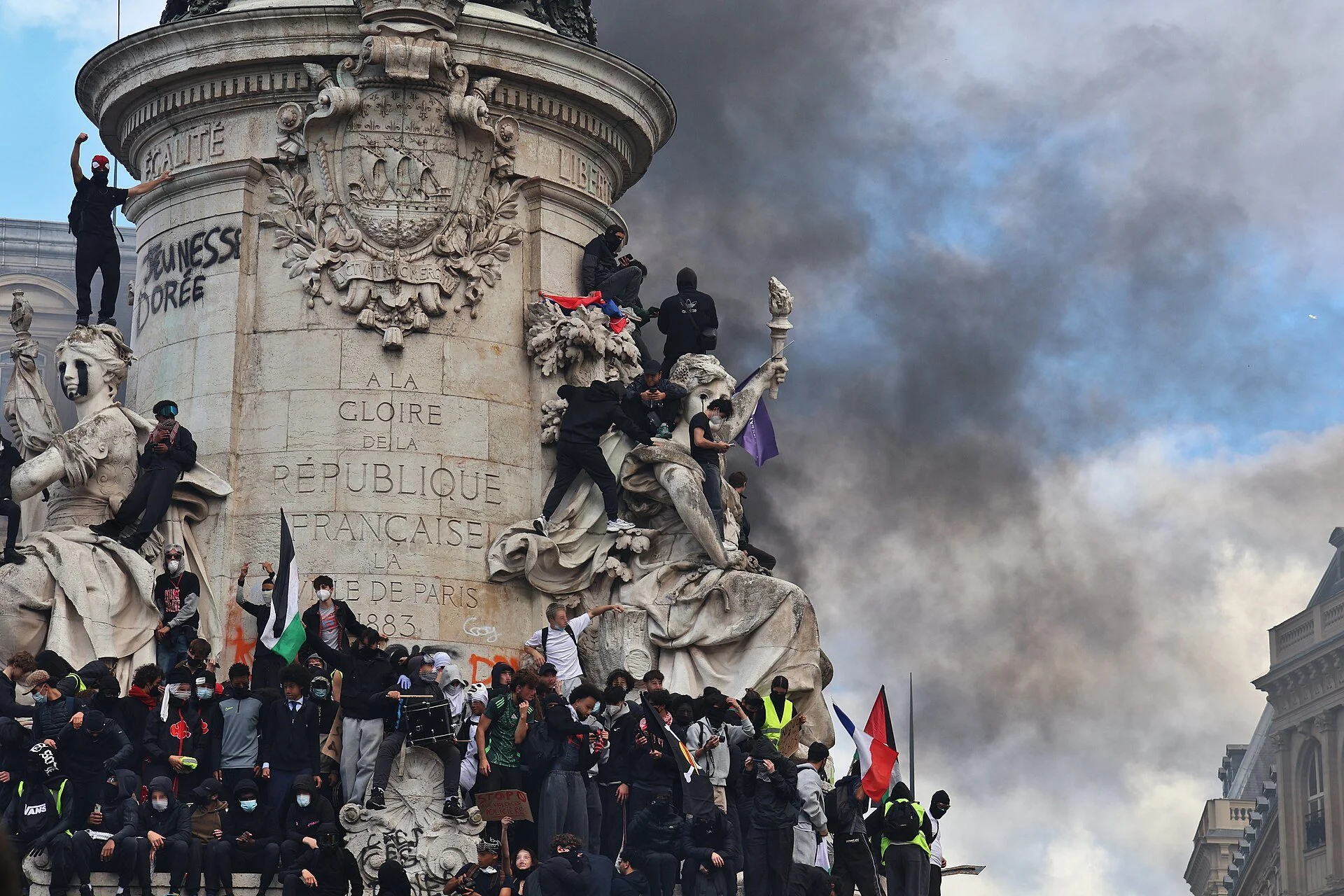
image credit: FreCha via Wikimedia Commons (Photo: 17/10/2026, Paris)
France. Italy. Portugal. Belgium. Spain. Albania.
The widespread demonstrations and violence in these countries across the last two weeks has turned the continent into a physical and political arena, dangerously giving the far right an opportunity to come even closer to power.
The protests were sparked by a culmination of issues. They initially started in France, with students protesting over ‘understaffed and dilapidated’ schools, particularly in poorer neighbourhoods. Elsewhere, protests about rising living and housing costs have gripped Belgium, Italy, Portugal, and Spain, whilst protests in Albania and Serbia have focused on perceived corruption and living standards. The demonstrations have descended into nothing short of chaos: over eight major cities in France alone have fallen victim to disorder, with even the Limoges city hall going up in flames. There have been countless injuries and thousands arrested; it is estimated that the damages will cost millions to fix. But who actually benefits from cities turning into battlefields?
Simply put, when day-to-day living becomes impossible, unrest erupts. The protests expose very real social and economic grievances. These are undeniably systemic problems that require an acceptance of complexity to fix. But that’s not what the far right want you to think.
Instead, the far right have jumped upon this violence, using it to propel their harmful agenda forward. After all, they thrive off division. Any populist agenda, left or right, creates a social dilemma of “us vs. them”, an inherently divisive logic. The far right have been forging an image of an impending apocalypse due to liberal values for over a decade. Consider Farage’s infamous “breaking point” campaign in 2016, to current slogans such as “save Germany”. Far-right populism succeeds by making people angry and anxious and offering simple solutions in return by creating a common enemy to further division and hatred. This isn’t shocking information. Elon Musk even made claims that a “civil war” in the UK is “inevitable”, and that there must be “revolutionary government change”. Just a reminder that he hasn’t visited the UK since 2021.
The current protests are therefore a dangerously perfect political opportunity for the far-right under this narrative that divides society by funneling frustration towards a certain group of people. Protestors are angry and they want someone to blame: immigrants, once again, becoming the classic scapegoat. In France, protests were ignited by educational concerns, but Le Pen was quick to highlight “anarchic immigration”, a completely separate and unrelated issue. Similar reactions were seen in the other affected countries too, with phrases such as “uncontrolled influx of people from abroad” and "imported violence” being hailed as the chief causes for the protests by the ultra-nationalist parties. This is simply not true. The actual reasons for their frustration are far from simple: they include structural issues that range from housing to education, to inflation, corruption, and more.
It is important to note that the far-right is not an isolated force and doesn't require a strict geographic location. This was made clear by Trump’s comments over the protests, declaring an “invasion” by “jihadists” in France, a so-called “third world takeover”. The far-right typically moves as a collective body across borders that manipulate unrest, moulding it into their socially harmful agenda rather than attempting to address the root causes. The danger therefore is not simply that the far-right exploits disorder, it is that by substituting scapegoats for solutions, it deepens the divisions that make democratic politics vulnerable in the first place.
Elections loom in the impacted countries: Spain’s snap election takes place in late November, and Macron’s term is coming to an end. The far-right will have undoubtedly gained more support from these events. They ultimately thrive in a polarised society, and should they come to power, they will exploit this division even further.