
Image Credit: Paulus Hector Mair via Wikimedia Commons
On the eve of Halloween, two knights met in East London for a mediaeval joust atop trusty Lime bikes, armed with colourful lances; but how did so many Londoners find themselves witnessing such a bizarre event?
Throughout the year, several unlikely competitions have taken place across London, such as this jousting spectacle in which two locals aimed to give back something the city had lost: community. A dramatic behind-the-scenes film was released by Tyler Palmer, who created the cinematic film from the perspective of the crowd. He described the event as one “where someone has a ridiculous idea, their mates help to make it happen, and strangers turn up like they've known each other for years”. Suited with armour and capes, this event has been described as performance art, harmonising the past and the present by using the Lime bike - something so intrinsic to modern London - paired with fantastical mediaeval customs.
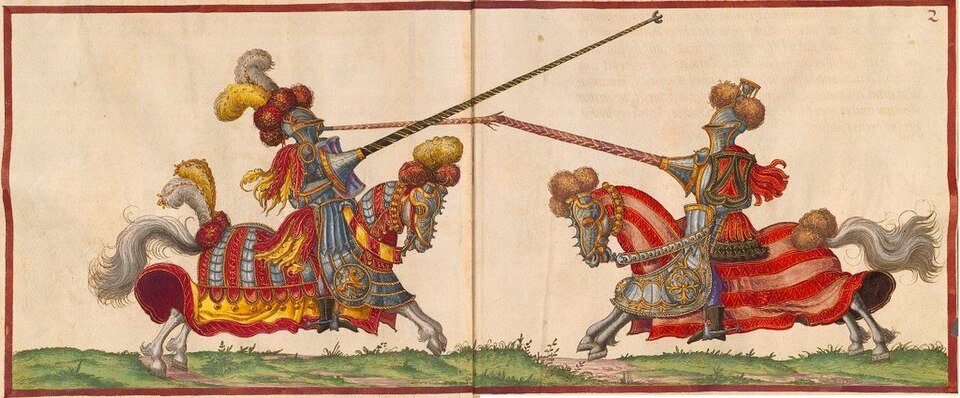
Going back in time, jousting evolved from medieval cavalry training into a high-stakes competitive sport. By the 16th century, jousting had become a spectacle including theatrical poetry, elaborate costumes, and rehearsed entrances. With the rise of gunpowder in battle, the sport died out by the 17th century, but in 21st century London, the spectacle is being reinvented.
In the past, jousting has been a show, its purpose to entertain and bring communities together. Today, jousting still fuses society, but also channels creativity and expression through sport.
But this isn’t the only event that has sparked community; the rise of the ‘lookalike competition’ has proved the antisocial Londoner stereotypes wrong. So far in 2026, we have seen lookalikes of Jude Bellingham, Tom Holland, Dev Patel, and Ali G take over London. Another popular event across the UK has been the ‘performative male’ contest. Born on TikTok, the event turns social media into something that incorporates rather than isolates.
So why has London fallen in love with such unconventional events? A 2018 BBC study found that 16-24 year olds are the loneliest group of people. This has likely only worsened after covid and is perpetuated further in such a large city, making Londoners yearn for community even more. Shared references across social media allow us to bridge this gap and find solidarity within a society that often lends itself to separation.
Furthermore, modern society is becoming increasingly more difficult and divided as we experience conflicts that threaten to separate us, meaning differences can overcome similarities. But with these events, London can form a community that has no boundaries or expectations. They offer a free, wholesome, and intriguing afternoon where politics are put to one side, allowing people a break from the turmoil of daily life.
These bizarre events are much more than people riding on bikes and poking each other with sticks. They are a way to get Londoners talking, a step towards Londoners taking out their headphones and restarting communities, particularly amongst young people. They are a step towards a future that is more creative and expressive than ever, allowing the community of the past to inspire our connections in the present day and come together after years of separation.