
Image Credit: Unknown via Wiki Commons
No country livestreams executions. Yet for one week in October, the United States planned to. On October 8th 2026, Defence Secretary Pete Hegseth confirmed the plan to livestream the death by firing squad of the Fort Hood mass shooter Nidal Hasan. This triggered national and international outrage, culminating in US President Donald J. Trump having to reverse the decision.
Backlash included 72 retired generals and senior military leaders arguing that such a spectacle would breach the Eighth Amendment, which states the US Constitution's protection against cruel and unusual punishment.The opponents condemned the idea as “a carnival for enjoyment of voyeurs and spectators”. Backlash was bipartisan, with members of both the Democratic and Republican party opposing the public execution. Additional critiques included the Catholic Church and the United Nations.
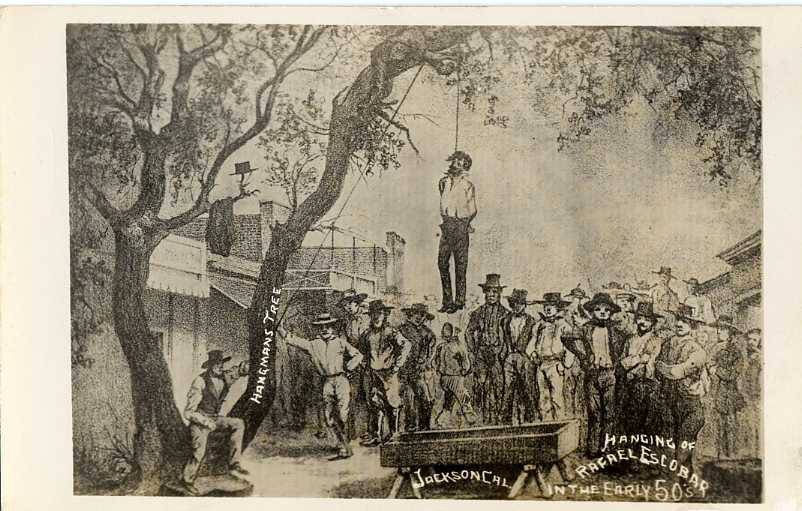
World history is filled with the concept of public executions. Since the existence of ancient civilisations in Rome, Persia and China they have been used as a tool of institutional and state control. In his seminal work Discipline and Punish (1975), French philosopher Michel Foucault argued that the modern West gradually abandoned this discipline model, moving punishment from the public square to behind prison walls. The shift, he claims, was less about mercy than control: public executions were unpredictable, and crowds could sympathise with the condemned just as easily, as they could potentially fear the state and ‘learn’a lesson. The United States was part of that transition, with its last public execution, the hanging of Rainey Bethea, having occurred nearly a century ago.
On August 14 1936 more than 20,000 people gathered to witness Bethea’s execution. Eyewitnesses recounted people bringing Coca-Cola cans and enjoying sandwiches, essentially treating the end of a human life as a community picnic. The spectacle and desensitisation surrounding Bethea’s death had ‘embarrassed’ many in Kentucky, leading to the Governor banning public executions just 18 months later.
The distasteful spectacle-making of the 1936 hanging would have undoubtedly been exacerbated by a livestreamed shooting. Bethea’s audience had to travel to Owensboro’s riverfront, Hasan’s would have only needed a cell phone. Imagine people lying in bed, watching the death of a human being, one hand full of crisps and the other already scrolling onto the next reel. A livestream would have distorted “justice” into a shallow spectacle, with death becoming an intimidation tactic of the US administration.
The phenomenon of ‘TikTok’-ifing criminal proceedings isn’t new. In July 2025, the White House posted footage of shackled deportees set to the viral “Jet2Holiday” sound on X. The caption read:“When ICE books a one-way Jet2 holiday to deportation. …Nothing beats it!”. Last month, its official TikTok account posted videos of ICE arrests to Zara Larsson’s “Midnight Sun”, captioned “never ending deportations". Outraged, Larsson immediately responded , calling the clips “so dehumanising”. The consequence of turning lawful punishment into exhibition is desensitisation, resulting of a society that eventually lacks empathy.
Hegseth’s reasoning behind the livestream was deterrence, claiming people needed to understand “there’s serious consequences for these types of things”. This is precisely the flawed logic Foucault warns against: punishment becoming less about justice and more about the state playing strongman.Trump revoking the original decision, was not a moral U-turn on the President’s part. He still describes the livestream idea as “a strong deterrent”, having only backed down after severe backlash.
Ironically, the intent to escape this kind of dehumanising treatment is the very reason many people came to America. In his 1989 farewell address, Ronald Reagan described the country as a “shining city upon a hill” with doors “open to anyone with the will and the heart to get here”. It had long been regarded as the land of the free, a safe place where rulers could not simply make a show of cruelty to prove their power. This was the promise of the American Dream: the belief that if you work hard, you will get ahead. Yet a dream like that relies on another promise, that the rules apply equally and that those in power answer to them as well.
The Founding Fathers themselves fought for freedom, revolting against their suppression by King George III. Their Bill of Rights, ratified in 1791, which includes the infamous Eighth Amendment, was written to protect people from their own government. Today’s government seems to have forgotten their roots. Now Lady Liberty waves at us, shouting: “Hello from America, The Paradox”.
Perhaps the next shining city, or the next Dream will not be American at all. Or perhaps, more bleakly, people have stopped dreaming altogether. Bethea’s crowd at least had to look up at the gallows. Today’s audience only needs to look down.