
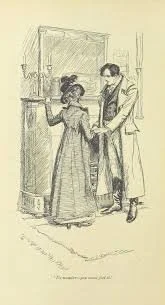
Image Credit: British Library via Picryl
With December 16th marking Jane Austen’s 250th birthday, historical houses and foundations across the country are holding celebrations and exhibitions to honour the iconic novelist. But it’s not just the curators that carry a love for Austen’s legacy. Despite only officially lasting from 1811 to 1820 (George III’s reign), fascination with the Regency Period has remained strong - especially if the many adaptations and historical dramas are anything to go by.
So why have empire waistlines and Elizabeth Bennet enchanted us for so long?
For one, the beauty of the era feels unmatched. The period’s neoclassical architecture and Georgian artwork is preserved in iconic houses including Jane Austen’s Hampshire cottage, but most captivating may be the Regency ball. Arguably the core of the Regency family’s social calendar, ballroom dances seem to lie at the heart of our fascination with the period. The décor, costuming, and theatricality of a Bridgerton ball is dream-like in its extravagance, but even the more realistic depictions feel endlessly romantic.
The ballroom wasn’t just reserved for the upper classes either: village balls held in assembly halls or country inns were often locally organised and open to all ticketbuyers (no invitation needed!). These events brought local communities together and facilitated networking and matchmaking – for instance, the Netherfield Ball in Pride and Prejudice where Elizabeth and Darcy have their first turbulent meeting.
Frankly, these kinds of gatherings seem to be exactly what people need today. While London has no shortage of events - life drawing, performative male contests, and supper clubs, to name a few - there’s something very different about having more formal, social events reliably baked into your social calendar; a place for the community to gather and be introduced to new people.
But the Regency Ball, as well as the rest of Regency life, wasn’t all harmonious. Etiquette handbooks like the Mirror of Graces will quickly tell you how tightly controlled social rules were; everything from the “detail of dress” to a lady’s “carriage and demeanour”, was restrictively micro-managed. Every social interaction was defined by stiflingly specific procedure and firmly established social hierarchy, especially true in the world of courtship. Although there’s something undeniably suffocating about that, the Regency world is also a world that lends itself perfectly to fictional drama.
And that may be where the real appeal of Austen’s heroines lies. As different as the Regency period is from our own time, Austen’s characters carry a timeless relatability. Many of their struggles, from familial problems to financial issues to (often most notably) romantic plights seem to speak directly to modern circumstances. In fact, Amy Heckerling, writer and director of Clueless only realised while developing the movie that the story of a teenager in Beverly Hills perfectly aligned with Austen’s Emma: “I wasn’t trying to say, “Here’s Emma.” I was trying to say that Emma makes perfect sense now.”
Despite the many ways in which our modern world is vastly different from Austen’s, and despite the appeal of a Regency fantasy, the similarities are really what’s made the period resonate, even all this time later.