
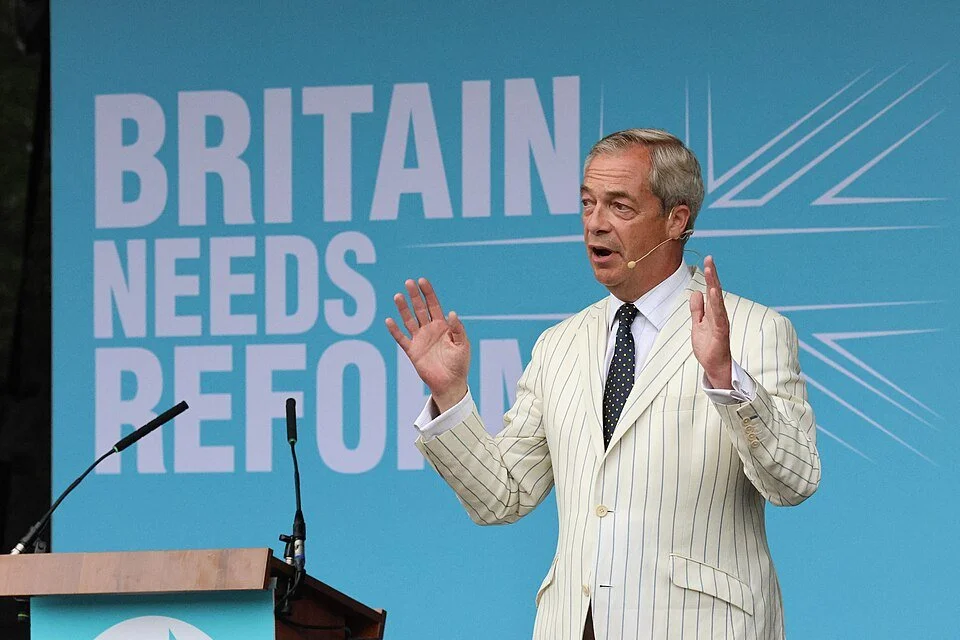
Image credit: Owain.davies via Wikimedia Commons
Nigel Farage has found himself in a rather convenient position. When the Conservatives disappoint voters, Reform UK benefits. When Labour fails to deliver, Reform benefits again. It sometimes seems that the party's greatest advantage is that it doesn't have to do very much at all. As long as people are unhappy (and they always are) with whoever is in Downing Street, Reform can present itself as the alternative. But for a party that has spent so much time explaining what is wrong with Britain, it is surprisingly difficult to work out what it actually plans to do about it.
This is not exactly a new approach for Farage. Long before Reform UK became a serious force in British politics, he had already built a career out of recognising public frustration and turning it into political momentum. With UKIP, he spent years campaigning for Britain to leave the European Union, an idea that for a long time had been treated as belonging to the fringes of British politics. Yet by the 2015 general election, UKIP had won almost four million votes, accounting for 12.6% of the total. It secured just one parliamentary seat, though its influence was far greater than its representation in Westminster suggested. The party had helped bring Britain's relationship with the EU to the centre of political debate, ultimately contributing to the pressure for the Brexit referendum and the media chaos around it.
When Britain voted to leave in 2016, Farage could reasonably claim to have achieved what he had spent much of his political career campaigning for. For most politicians, that might have been the end of the story. Instead, he found another opportunity. As Theresa May struggled to negotiate Britain's departure from the EU, frustration among Leave voters grew, and in 2019 Farage launched the Brexit Party. Its argument was straightforward: the political establishment had promised Brexit and was failing to deliver it. Within months, the party won the European Parliament elections with around 31% of the vote.
By then, Farage had demonstrated a particular talent for identifying when voters felt let down and giving that frustration somewhere to go. The issues addressed might vary, but his political formula remained very much the same.
Following Brexit, the party rebranded as Reform UK in 2021, broadening its populist focus to immigration, taxation, and dissatisfaction with Westminster more generally. By the time the 2024 general election arrived, the Conservatives had been in government for fourteen years, and many voters had grown tired of the party's repeated promises to fix problems that had developed under its own leadership. Reform was well placed to take advantage. With Farage returning as leader, it won more than four million votes and five parliamentary seats. Its success continued in the 2025 local elections, when it gained 677 council seats and took control of ten councils. What had previously been dismissed as a protest movement was beginning to establish itself as a more permanent part of British politics.
Yet the more successful Reform becomes, the harder it is to ignore the difference between its ability to attract support and its ability to explain what it would actually do with power.
Much of Reform's appeal rests on issues that genuinely concern voters. Immigration, the cost of living, taxation, and the state of public services are hardly newly invented problems. But the party has often been more convincing in describing these frustrations than in offering realistic solutions. Its proposals for lower taxes and reduced government spending, for example, sound attractive to an electorate that feels increasingly squeezed. The difficulty comes when those promises are considered alongside commitments to improve public services. The Institute for Fiscal Studies raised serious concerns about the financial credibility of Reform's 2024 manifesto, questioning whether its proposed savings could realistically pay for its tax cuts and spending commitments.
Of course, Reform is hardly the first party to make promises that appear much simpler on paper than they would be in government. The difference is that Labour and the Conservatives have records in office against which those promises can be judged. Reform, at least nationally, has largely avoided that. It can criticise government decisions without having to make many of the difficult choices itself.
The question is what happens if that approach succeeds. Farage has spent years telling voters why the people running Britain have got things wrong. If Reform ever finds itself in government, it will have to explain how it intends to get things right. And, for the first time, it may find that blaming the government is no longer an option.