
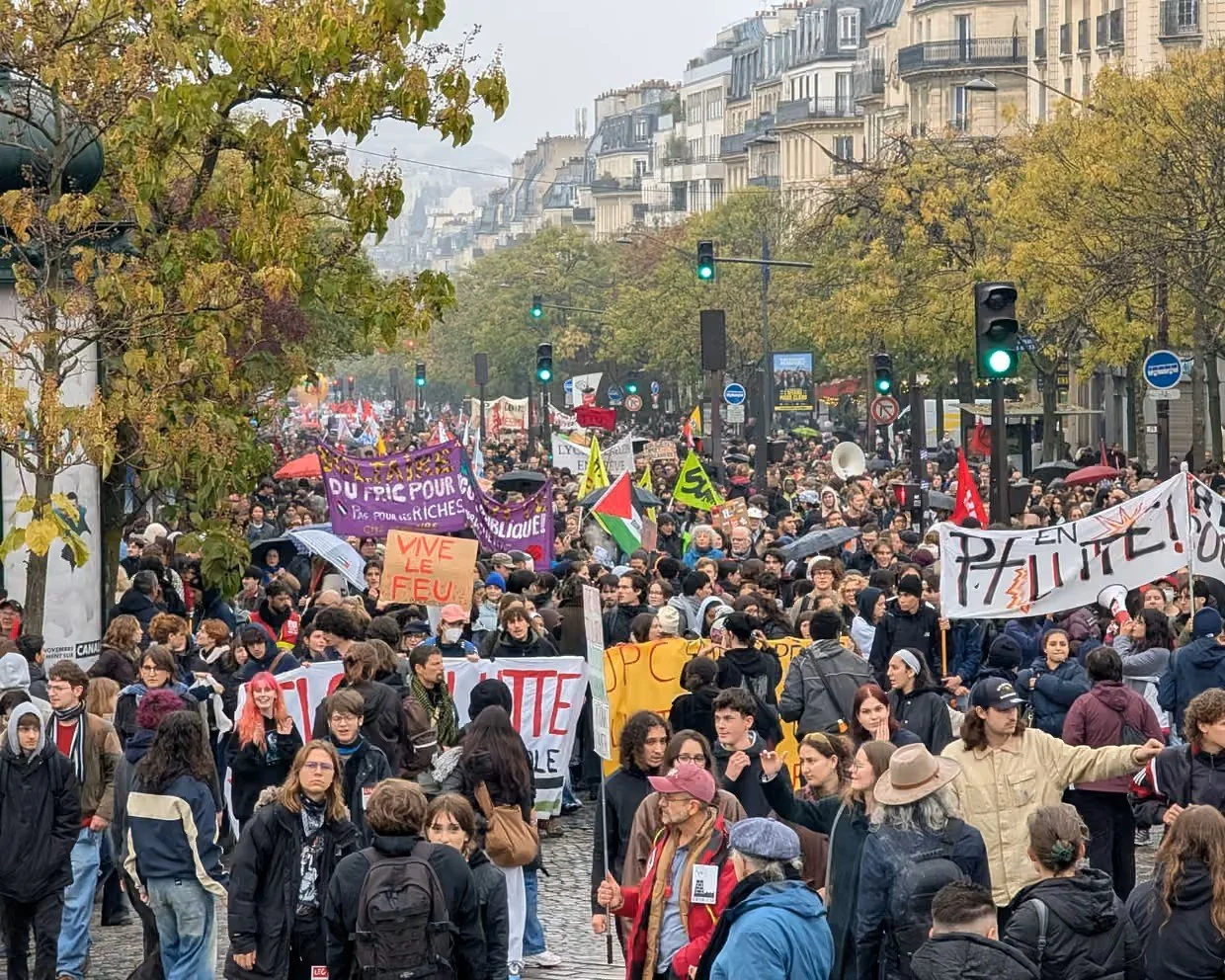
Luc Auffret/Anadolu/Getty Images via Guardian Website
Behind the images of looting, young people are demanding a future, to which the state answers only with force.
On 5 October in Lens, a 15-year-old pupil had his hand torn off by a police grenade. He was protesting for chairs, teachers, nurses and smaller classes. Yet the images of smashed shop windows on 17 October dominated the screens.
Since September, the government has not seen what the people in the streets see.
What is legal and what is just
Curfews for minors, protests banned in several cities, the threat of stripping those convicted of their right to vote. All of this is legal. The Conseil d’État (France’s highest administrative court) has even upheld it. But since when did the law gain a monopoly on morality?
French history has often been written in defiance of the laws of its time. Civil disobedience is not a whim; it is what remains when institutional channels stop responding, and today, they have. A generation is running up against Parcoursup, the platform that sorts access to higher education, against crumbling schools, against the impossibility of making ends meet. It asked to be heard, but the answer was to silence it.
Some will point out to me that shops have been looted and police officers injured. That is true, and I am not downplaying it. But that violence pales beside the violence of the institutions that exhaust and damage an entire society without ever making the headlines.
A crackdown that betrays fear
I have never seen France react like this. More than 5,000 people were taken into police custody in three weeks, nearly nine in ten of them minors, according to the French Human Rights League. That is as many as during a whole year of the gilets jaunes (yellow vests), the great social uprising of 2018. Teenagers have been blinded in one eye by LBDs, the rubber-bullet launchers. Armoured vehicles, the GIGN (Gendarmerie’s elite counter-terrorism and hostage-rescue unit) and soldiers have been deployed, including even elite units normally reserved for counter-terrorism. Amnesty International puts it bluntly: silencing dissent is one of the hallmarks of authoritarian practices.
The French police used to be called gardiens de la paix, "keepers of the peace". Today they are forces de l'ordre, "forces of order". The shift is not merely semantic: it reveals who is being protected, and from what.
Such a deployment reflects not the strength of a state, but its fear: the fear of seeing the established order falter, six months before a presidential election.
What the cameras don't show
It looks as though a scapegoat was needed. That role fell to La France insoumise (LFI), the main left-wing party supporting the movement. The President speaks of far-left "seditionists". The government accuses LFI of fuelling the violence and, according to Mediapart, it may even have tried to steer the intelligence services in that direction.
Meanwhile, the far right has never polled so high, and some media outlets are giving it free rein, between scenes of looting broadcast on a loop and speeches with a presidential air. Branding the left an enemy of the Republic just as the far right stands on the brink of power: that is what should alarm us.
Yet there is another version. What I see, and what the videos filmed by the protesters themselves show, is a completely different picture: pupils joined by university students, then by teachers, farmers, firefighters, healthcare workers and gilets jaunes. Generations and professions that had stopped speaking to one another are now marching side by side. This solidarity is the real political event of this autumn, and it is precisely what nobody shows.
To dismiss this movement as mere savagery is to refuse to hear what it is crying out: the suffering of a country in crisis. Fires can be put out. Anger cannot be beaten into silence.