
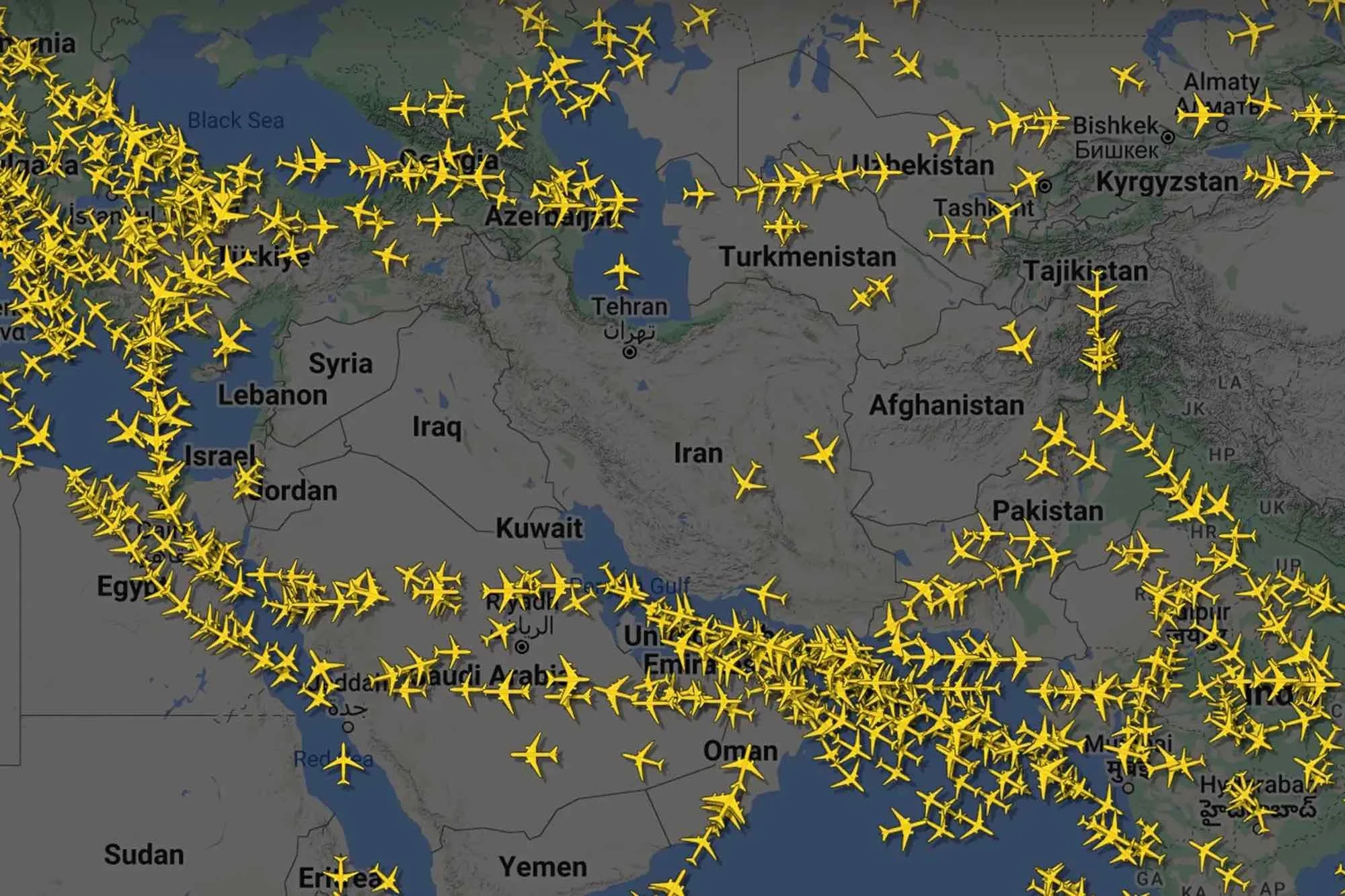
Image Credit: FightRadar24
On 28 February 2026, a joint operation conducted by the United States and Israel launched its first strikes on Tehran, targeting Iran’s political leadership, military infrastructure, and suspected nuclear facilities. Iran responded with retaliatory attacks on military bases used by the United States across the region, rapidly escalating the conflict. As a result, the Middle East has effectively become an active war zone, with several Gulf countries either directly struck or drawn into the expanding confrontation.
With ballistic missiles, interceptors, and aerial bombardment dominating the skies, commercial flights operating through conflict-affected airspace present significant and unnecessary risks for passengers, airlines, and insurers. Modern air defence systems and long-range missiles can reach cruising altitudes used by civilian aircraft, making accidental or misidentified strikes a real possibility. In highly volatile conflict zones, the failure to close or properly regulate airspace can therefore expose civilian aviation to dangers that far exceed normal operational risk.
What you need to know about extensive flight delays and cancellations:
The world’s airspace is divided into Flight Information Regions (FIRs), which generally correspond to national airspace boundaries and are managed by the relevant country’s air traffic authorities. In response to the conflict, authorities issued Notices to Air Missions (NOTAMs) announcing the closure of large sections of airspace across the region. Airlines must comply with these restrictions, but they also make independent operational decisions, with insurance companies assessing the risks associated with flying through or near conflict zones.
The biggest challenge now is that avoiding the Gulf region forces airlines to reroute long-haul flights. Aircraft must either travel north through the Caucasus, skirting below Ukraine’s already restricted airspace, or fly south via Egypt, Oman, and Saudi Arabia, where the proximity to active conflict still poses risks. These longer detours also complicate flight planning, particularly regarding fuel loads, refuelling stops, and aircraft range.
Beyond the logistical and financial challenges facing airlines, the disruption has also left thousands of passengers stranded across the region. With airspace closures forcing widespread cancellations and diversions, travellers in Gulf transit hubs and nearby countries are facing prolonged delays, uncertain rebooking options, and limited routes out of the region. For many civilians, particularly migrant workers and tourists, the sudden transformation of the region’s skies into contested airspace highlights how rapidly geopolitical conflict can disrupt ordinary mobility and leave individuals caught in the wider consequences of war.