
Banksy Cover Blown? Reuters Says Yes, but What Happened to Artist Anonymity?
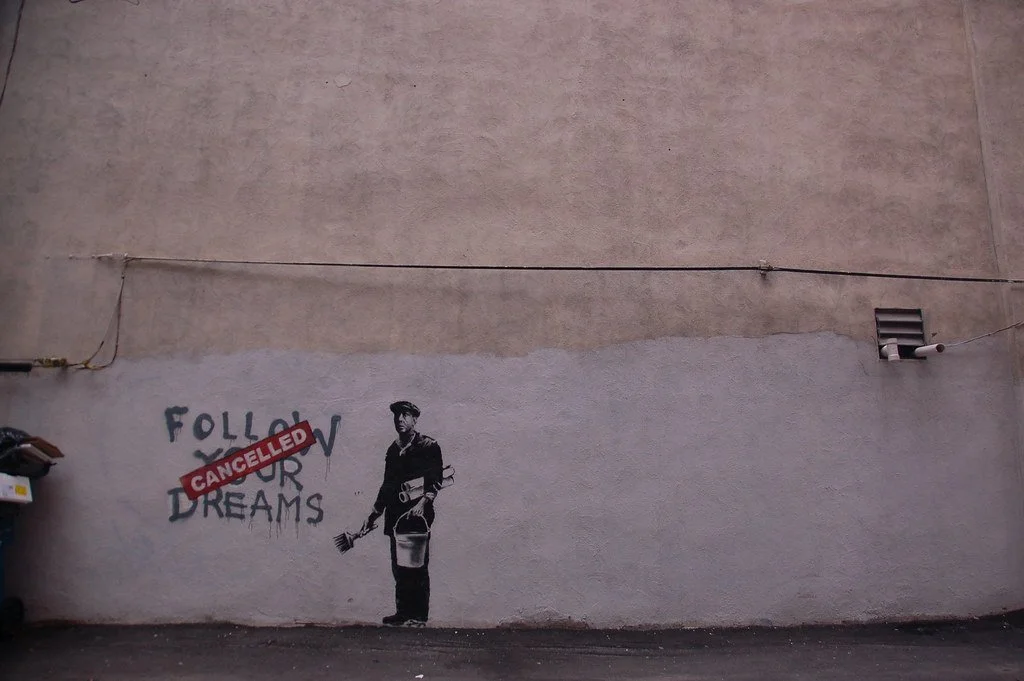
Image Credit: Chris Devers via Flickr
Heart shaped balloons, shredders in picture frames, and black and white stencilling – all typical images conjured by the name “Banksy”. One that doesn’t come to mind, however, is the artist’s own face…
Throughout his career, the mystique surrounding Banksy’s identity has been one of his greatest works of art. But that has come with a decades-long hunt for the man behind the spray paint - and a recent Reuters investigation claims to have solved one of the art world’s greatest enigmas. Have they really discovered anything new, though? And - perhaps more importantly - does this revelation shred the socio-political commentary that makes his art so beloved?
Reuters’ investigation investigated Banksy’s 2022 mural in Horenka, Ukraine, concluding that the notorious artist was none other than Robin Gunningham (though he appears to go by “David Jones” in more recent records).
Such claims cannot be said to be new, or particularly surprising. In 2008, the Daily Mail publicised arrest records for the vandalism of a New York billboard in September 2000; these also allegedly contained his real name. Going further back still, even four years earlier in 2004, it appeared Banksy was “Unmasked at Last” when his photograph (captured by Peter Dean Rickards) appeared in the Evening Standard.
But does any of this truly bring us closer to finding Banksy? Despite the cracks in his mask, Banksy’s identity still seems reasonably concealed. His former manager Lazarides told Reuters that they were ‘pursuing a ghost’: Robin Gunningham was “killed years ago. You’ll never find him.” It would be unsurprising if “David Jones”’ was killed off in the same manner, given speculation that the artist has since changed his name again.
Photographs are similarly unpromising evidence. Aside from Rickards’ photos and one on Lazarides’ Instagram, Reuters found another potential photo taken by Robert Casterline at the infamous 2018 Sotheby’s auction, where his Girl With Balloon was shredded by its own picture frame. However, Casterline has since refused to share the full image, stating: “I don’t want to be the guy who exposes Banksy”.
Banksy’s elusiveness appears to be at the heart of his mass appeal, shared by the public and art world alike. Despite art dealers’ insistence that buyers’ interest is not because Banksy is “masked”, the intrigue certainly increases his popularity; in 2024, Lazarides auctioned off 15 burner phones used to contact Banksy, fetching $15,875.
The enigmatic origins of Banksy’s art mean it exists without being ‘anchored to a singular authorial persona,’ writes Time magazine. The very fact of his anonymity stages his work as vandalism, and therefore an astute socio-political commentary: rather than simply a product of its artist, his work is firmly situated outside the realm of commerce and celebrity.
There’s the question of artist privacy, too. Interest in Banksy’s identity could result in intrusion into his personal life - for instance, the New York Post’s investigation of his marriage. Without anonymity, his social commentary could also face “retaliation, censorship or persecution”, Banksy’s lawyer Mark Stephens says.
The desire to unmask Banksy is expected given that much of his fame is a product of his intrigue, and it’s natural to want to make sense of the source of such unpredictable and incisive artwork. But perhaps we should be asking whether this understanding is really worth it when it threatens the provocative commentary for which Banksy has become so revered.