
Image Credit: Izzy Huntley
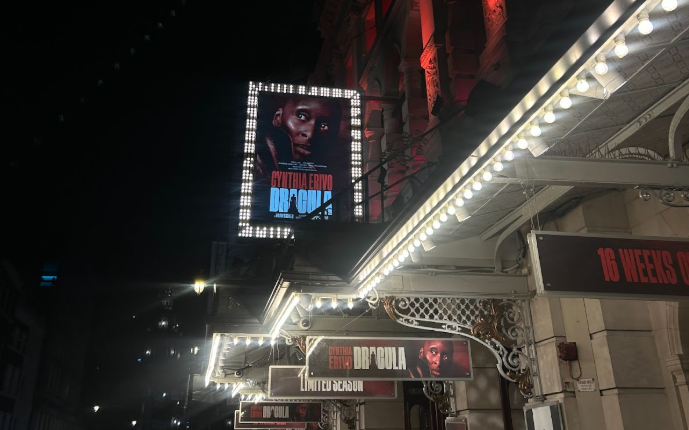
As Cynthia Erivo unassumingly snuck on stage at the Noël Coward Theatre, wearing no costume, tattoos and piercings on display, I started to wonder what I was doing there...
As a self-proclaimed Dracula obsessive – and perhaps slightly snobby English student – my expectations for a Dracula adaptation were incredibly high, as was my anxiety, right up until the start of the play about just how faithful such a contemporary one-woman, multi-media production could be. However, I am glad to say that my apprehension was entirely unfounded.
The play starts just like the Victorian Gothic novel (unlike a certain recent cinematic Brontë adaptation), with Erivo’s take on Jonathan Harker as he travels eastwards. Slowly but surely, the rest of the characters are introduced, via the eventual employment of costume, and unbelievably smooth transitions between both scene and narrative voice. The structure of the novel is cleverly replicated, and the play stays largely faithful to the original plot, the various diaries and memoranda of each character recounted via Erivo’s incessant and hugely impressive 20,000 word monologue. I went to one of the last preview shows, thus there were one or two slight stumbles, but overall her delivery was astounding. Playing such a vast cast of characters could not be achieved by everyone, but Erivo is of that particular calibre of talent where she can make the audience believe just about anything that she wants them to - if she can defy gravity, what’s stopping her from taking on the most iconic bloodsucking vampire of all time?
Some parts of the book were certainly changed (no spoilers!), but its thematic interpretation was, for me, perfect. Her Dracula has lost his Romanian accent in favour of a Nigerian one for example, and the connection between Mina and Lucy becomes much more intricate, showing how the narrative still provokes discussion and interpretation through many different lenses today. What’s repressed in the novel is subtly pushed further into the light: themes of homosexuality and xenophobia are amplified through slight tweaks of plot and Erivo’s characterisation. I found that this made it even more faithful to the book, less concerned with being the same line-by-line, but instead maintaining its core essence and opening up discussion of wider themes and concerns.
Although she stands entirely alone on stage, screens all around the theatre show not only the on-stage action but also previously recorded segments that appear to feature an entire cast. When I had sat in my seat earlier, I wondered if I would feel more that I was watching a film, and whether it was worth paying to see the show in person, but by the end I was entirely converted to this form of theatre. This style has become signature for director Kip Williams, who designed an adaptation of The Picture of Dorian Gray starring Sarah Snook in all roles, in 2024. Its effectiveness seems to draw from its ability to create a tangibly tense atmosphere within the space, and also, at its heart, feels more inclusive for those with seats further away, who are still able to appreciate the in-person production, but can have their experience and view further enhanced.
On paper, this production seems like it has absolutely no way of working, but it must be seen to be believed. Finally, my favourite book has an adaption that is neither unoriginal nor vastly different, but – in a world full of ignorant transformations of Gothic romance – Kip Williams and Cynthia Erivo have made the interpretation that we need today.