
Image Credit: Harper’s Bazaar
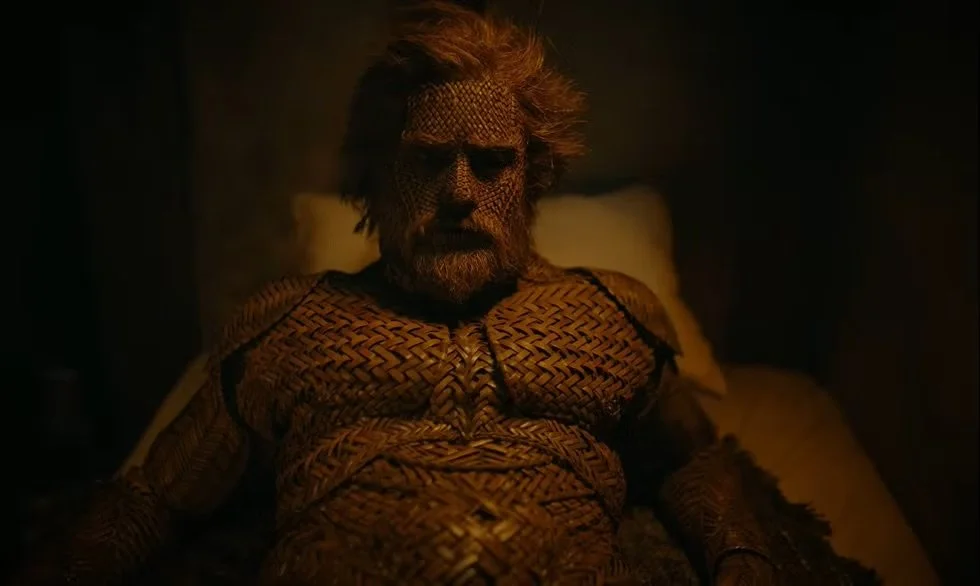
Alexander Skarsgård’s woven willy has arrived on the big screen, thrusting the monster romance into popular culture once again. Wicker follows a common trope of the genre; a human woman falls in love with a monstrous, non-human male. The list is endless when it comes to this dynamic: Beauty and the Beast, The Shape of Water, Edward Scissorhands. A mainstream film featuring a male main character being able to look past the ugly or freakish outer appearance of a woman, to learn to love how she is on the inside, is few and far between.
Do the stereotypical traits of a monstrous lover (protection, domination, and power, to name a few) align more easily with masculinity in a heterosexual relationship? Or is what women desire and fantasise about in men often so far removed from the unfortunate reality of the 21st century man that they subvert what should be considered frightening or disgusting into something erotic? Either way, the phenomenon of the erotic monster is firmly male dominated.
Everyone is familiar with the story of Beauty and the Beast, of how a young girl falls for her older male captor despite his beastliness of both appearance and behaviour, at least initially.
Women are expected to give men grace for their flaws: social media loves to praise the ‘medium ugly man’ as perfect boyfriend material. The reversal seems to be rarer, in both life and pop culture.
This isn’t to say that women are completely excluded from depictions of monstrosity; in Jennifer’s Body, the titular character becomes a literal man-eater. However, one has to compare how Jennifer is depicted versus characters like the wickerman, or the fish man from The Shape of Water. In the latter, he is an object of eroticism because of, first and foremost, his ability to emotionally connect with Elisa; his monstrous physicality is appealing because of his ‘otherness’, which Elisa relates to. Comparatively, Jennifer is heavily sexualised, arguably for her femininity rather than her monstrosity. Evidently, there are differences in how male and female monsters are eroticised.
Many of these monsters are perhaps so desirable because they bridge the gap between what straight women want from men, and what reality presents. One only has to observe the skyrocketing popularity of series such as A Court of Thorns and Roses (sales of sci-fi and romance books increased by 41.3% between 2023 and 2024). Meanwhile, the 2025 National Dating Landscape Survey found that three-quarters of American women aged 22-35 reported they had not dated or dated only a few times in the last year. With the current dating landscape of male prospects ranging from the performative to the avoidant, fiction seems an understandable alternative.
On a more serious note, with 1 in 4 women in the UK experiencing sexual assault since the age of 16, monster romance becomes an escape from reality. Angela Carter warns women of men who are ‘hairy on the inside’ (Angela Carter, The Bloody Chamber and Other Stories, 1979). With a beautiful outer appearance not necessarily reflecting what’s within, perhaps it’s unsurprising many heterosexual women turn to the opposite; a man who appears beastly but actually caters to what they really want: love, respect, and prioritisation.