
image credit: Nurken via Wikimedia Commons
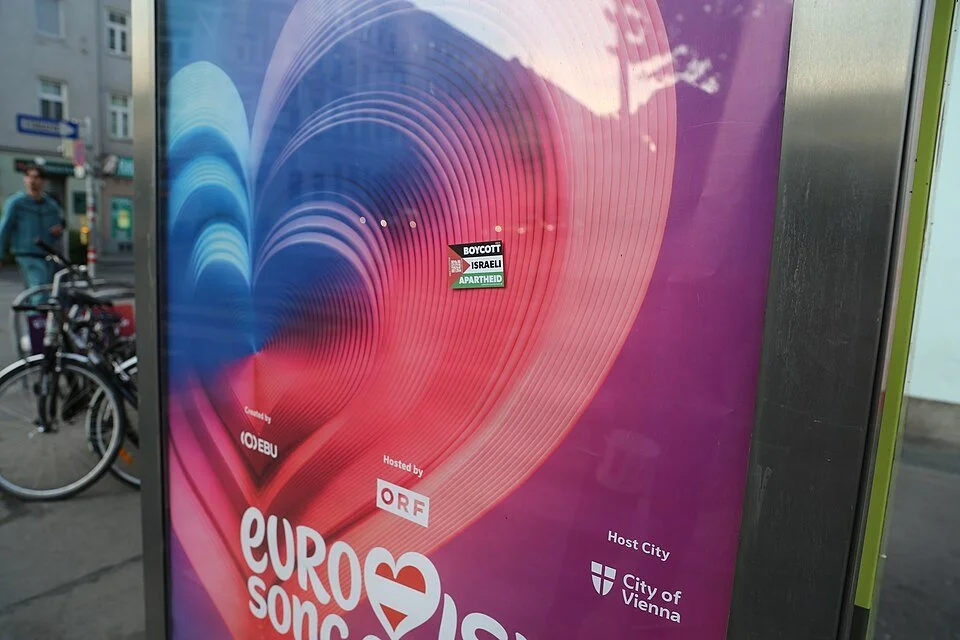
It's the one night a year when Europe (and Australia) flock together to sing and dance for douze points. It’s Eurovision: a flamboyant expression of self-identity, showing millions of viewers a country's language and traditional music. From the likes of Latvia to Azerbaijan, it's the chance to immerse yourself in Europe's rich diversity. In recent years, the anticipatory excitement for the big day has been softened by boycotts: from countries and broadcasters pulling out, to disqualifications due to political lyrics, and fans refusing to watch. The show has been described by the National Public Radio (NPR) as a “political flashpoint”, completely undermining Eurovision's neutral stance. It seems that politics now takes to the stage as opposed to hopeful contestants. So in what ways has the event been swept under by politics, with boycotts ultimately encouraging fan disappointment?
Eurovision has long described itself as a politically neutral event: the politics of each country are not up for discussion. This explains why in 2024, the Israeli contestant had to change their song title from "October Rain" to “Hurricane”, for fears that it was a direct commentary on the conflict in the Middle East. But the same regulators also pulled Russia out in 2022 in a bid to protect the contest's reputation in light of the Ukrainian war … Either way, Eurovision's neutrality doesn't seem very clear-cut.
Politics always resurfaces, and often, it is completely out of Eurovision's hands. The Netherlands and Ireland have pulled out of the 2027 contest, with the Dutch broadcaster citing “sensitivities surrounding the themes currently at play”. The likes of Slovenia and Spain continue to maintain their own boycotts, due to Israel’s active participation. On an artist level, 2024 winner Nemo, representative of Switzerland, returned their trophy early, as a way of protesting peacefully. With Eurovision as their platform, these boycotts have allowed protesters to make it clear that they cannot accept real humanitarian issues, by drawing attention to the controversy and encouraging the European Broadcasting Union (EBU) to make rule changes. Recently, organisers introduced rules preventing broadcasters in conflict-affected regions from automatically hosting the following year's contest, regardless of if they bag a win. The changes were intended to ensure the competition could be staged safely, although they do not prevent those countries from directly participating.
With Israel still invited to take part, these protests aren't simply performative; they’re also frustrating for fans. Having heard that the Netherlands would not be participating, I thought back to 2019 and the subdued performance of Duncan Laurence, who won with his powerful piano rendition of Arcade. His victory shows that a lot can be lost when a country withdraws. It isn’t just fans that are affected – there's immense pressure on the performers too. Israel’s 2025 artist Yuval Raphael told the BBC she had "practised being booed" during rehearsals. Blame is directed towards the representatives of the country when they are just that: representatives. However, the introductory segment, where contestants come out with flags, arguably showcases nothing but national pride. It is clearly a fine line.
So, can Eurovision be neutral? Can we watch the show without involving politics? Or see contestants without seeing their country? It's a show created to celebrate national identities and put aside hostilities. Yet recent boycotts have brought these hostilities further into the spotlight. We’ve seen how harshly contestants are judged by their representative countries and Eurovision has shown that sometimes it does take sides. So while it may be hard to put aside politics per se, if possible, perhaps the UK will avoid getting null points next year.