
A hand-drawn radio appeared on the screen. Then came the voice of a poet who had died a decade earlier. At UCL’s Faculty of Laws on 9 October, the audience heard South African poet Adam Small reading What abou’ de lô. Written in 1962 and adapted into an animation by Charles Badenhorst in 2014, the poem questions Apartheid-era laws that prohibited marriage across racial lines. Those laws have long been repealed. Yet in the room that evening, Small could still be heard questioning the authority behind them.
That is one thing art can do. It need not reveal a new fact to change what a fact means to us. Knowing what the law prohibited did not settle the question Small was asking: what gave the state the right to decide whom people could marry? The radio, the voice and the moving drawings did not explain the legal system in detail. They made that question difficult to leave in the past. The screening was part of A LUTA CONTINUA, a discussion accompanying the UK debut of selected works from the South African Constitutional Court Art Collection.
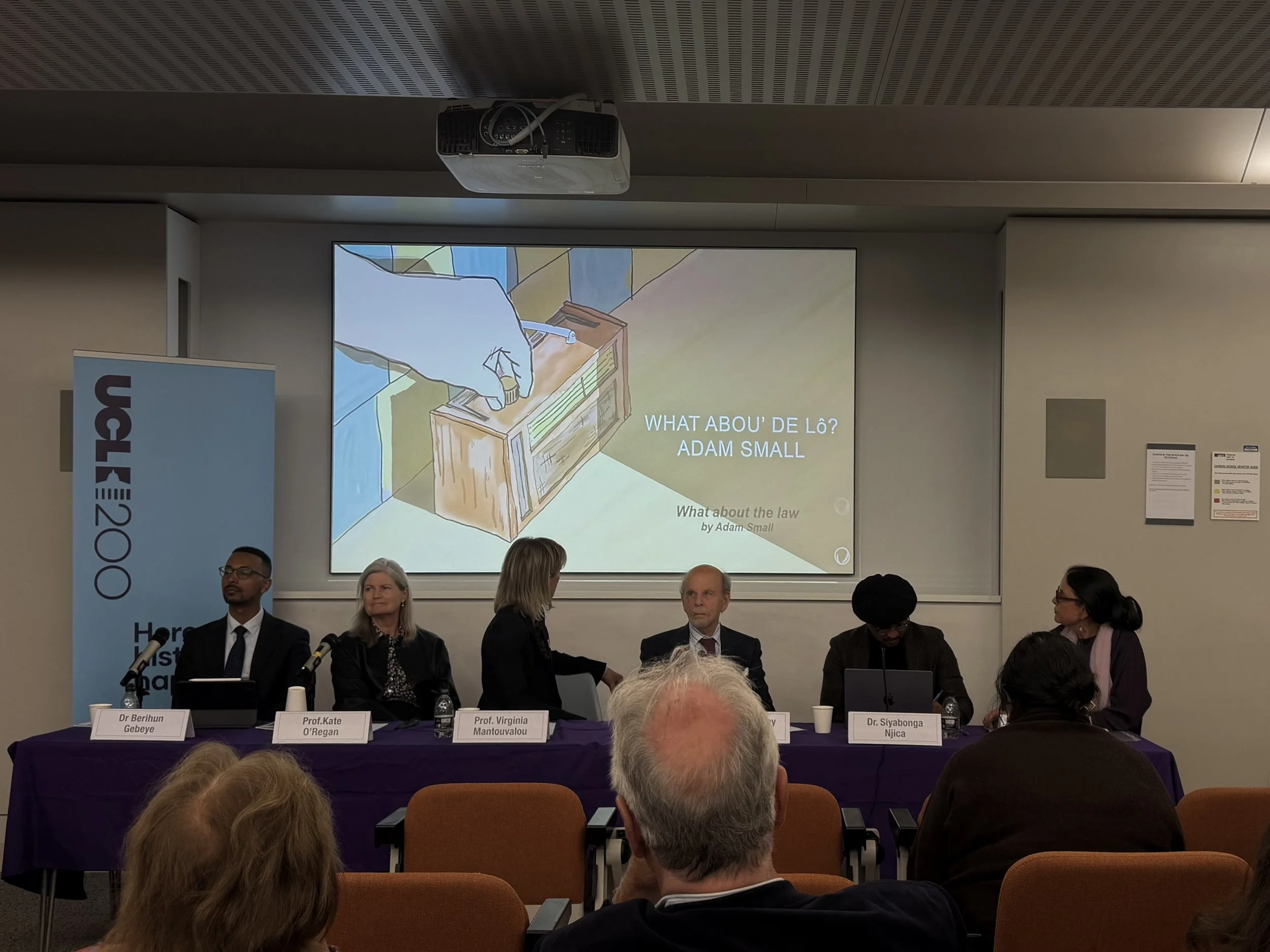
Image credit: Renee Li
Among the speakers was Kate O’Regan, one of the Court’s first judges. The discussion explored how constitutional values such as dignity and equality relate to people’s lives, and what role courts can play in making those ideals meaningful. These questions point to a gap that a legal victory alone cannot close: people may have rights on paper without always having the means to exercise them. Under apartheid, law did more than fail to prevent discrimination; it helped organise it. The ban on mixed marriages was repealed in 1985, years before South Africa’s transition to constitutional democracy. These changes could not instantly undo the inequalities apartheid had helped create.
In 2020, artist Marlene Dumas purchased Badenhorst’s film and donated it to the Constitutional Court Art Collection. The gift would allow Small’s voice to continue being heard in the Court. A court usually speaks in judgments; here, it makes room for someone who speaks back. South Africa’s post-apartheid Court did not make those discriminatory laws, and preserving art cannot undo their harm. A place in the collection does not mean the film’s challenge has been answered. It does, however, keep that challenge within reach of future audiences. The question is no longer whether those laws should remain in force. It is how a society remembers what was once done in the name of law — and what it expects from law now.
The distance that voice had travelled was remarkable. A poem written in South Africa more than sixty years earlier had become a recording, then a film, and finally part of a collection brought before an audience in London. For those far removed from the time and place in which Small wrote, the film offered a chance to hear his question in his own voice. That chance depended on people choosing to record, preserve and share the work.
A luta continua means “the struggle continues”. The film cannot reverse what Small wrote about, any more than a court can repair the past by preserving it. But on a Friday evening in London, more than sixty years after his poem was written, a roomful of people was listening to him ask his question again.