
Hamnet: The Boy Behind the Bard
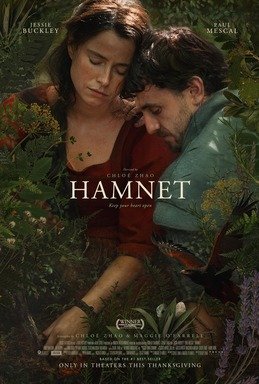
Image via Wikipedia
Hamnet Shakespeare exists almost entirely in absence. Baptized in 1585 and buried in 1596 (likely claimed by the plague), he is a mere name in a parish register, a shadow lingering at the margins of memory. Yet in Maggie O’Farrell’s 2020 novel Hamnet, and Chloé Zhao’s luminous film adaptation, that shadow acquires substance: the boy becomes a prism through which we apprehend love, absence, and the delicate architecture of domestic life. Here, history is not a ledger of events but a scaffold upon which imagination, empathy, and the arts construct truth.
Critics have inevitably fixated on literary causality: Hamnet did not – despite the interchangeable spelling of the name in the Elizabethan period – inspire the construction of Shakespeare’s notorious tragedy, Hamlet. Nor do we know any historical details regarding the courtship of Agnes (Anne) and Shakespeare. However, to insist on this pedanticism misses the film’s fundamental achievement.
Hamnet is not a historical document; it is a meditation on grief, devotion, and the human condition. It asserts that art, at its most profound, grows not from chronology but from the fertile soil of emotion. Jessie Buckley’s stand-out performance as Agnes “could well shatter your soul”, her sorrow rendered in gestures small yet devastatingly precise leave me without doubt of an impending Oscar nomination (and a potential win).
Audience responses – shared silence, soft sighs, and tears shed quietly in the dark – attest to its visceral impact. The cinematography deepens the intimacy: light sifts through windows like memory, storm clouds echo interior tumult, and landscapes unfold with a poetry that renders the external world a mirror of emotion. Every frame lingers on texture, gesture, and silence, revealing cinema’s capacity, like theatre, to make internal life tangible and communal.
In an era where the humanities are under threat, where literature is compressed to bullet points and theatre struggles for relevance, Hamnet stands as a clarion call for the enduring power of the arts. It demonstrates that storytelling is never frivolous; it preserves memory, conveys emotion, and fosters connection across time. To debate historical accuracy is to miss the point entirely. The film asks us to inhabit feeling, to witness absence, and to recognise the quiet, sustaining labour of love which shapes human existence.
Ultimately, Hamnet is about presence and absence, about the invisible bonds that hold family, memory, and art together. It illuminates the subtle architecture of grief, the endurance of love, and the ways in which the arts render these truths eternal. In this film, a boy nearly lost to history becomes a mirror for every human heart, reminding us that the power of art lies not in fidelity to fact, but in its capacity to reveal the profound humanity that endures beyond time.