
Image Credit: AP News
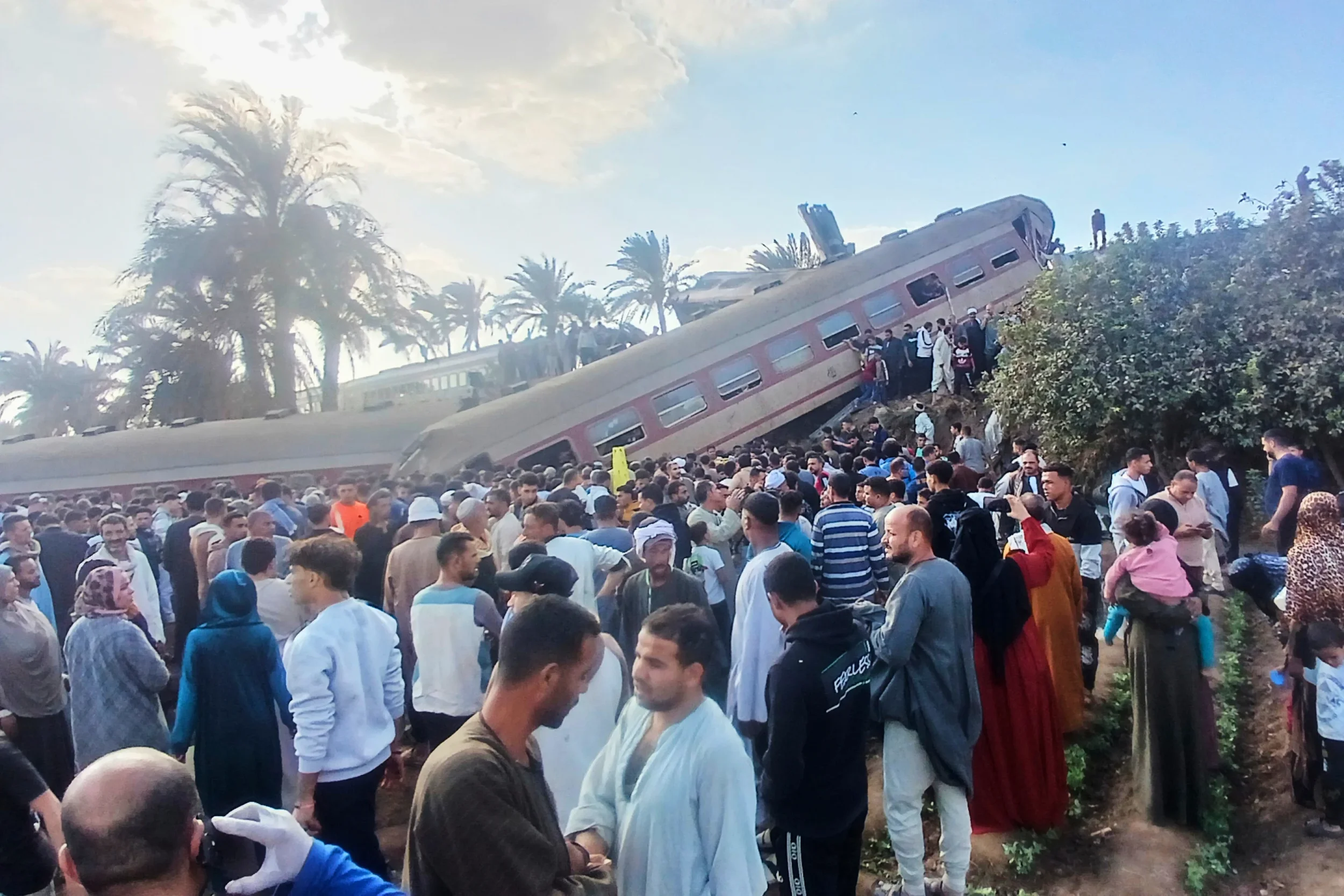
A train collision in al-Ayyat, Egypt, has resulted in seven fatalities and over 112 injuries.
Sunday’s accident caused severe damage to both trains. The first was travelling to Fayoum, around 100km from Cairo, while the second was heading south to Aswan, nearly 900km away.
“We heard an extremely loud crash,” Mahmoud Salama Ammar, a local resident, described to Reuters. “The train heading to Fayoum had collided with a stationary train” and sustained immense damage, whilst “six carriages from the train from Cairo to Fayoum were overturned and piled on top of one another.” He alleges that a train driver was amongst those killed.
First-hand accounts and testimonies from survivors are scarce at this stage, both due to the recency and severity of the event (leading to hundreds of hospitalisations) but also, as the BBC describes, because most passengers are from poorer communities who may not own smartphones, delaying the spread of information.
Train travel is one of the most affordable ways to navigate Egypt, and both services involved in the accident are widely used by lower-income passengers. Tickets to Fayoum and Aswan cost under $1 and $10, respectively.
Egypt introduced the first railways in the Middle East and Africa, services which currently provide transport for 110 million people. Despite the billions poured into high-speed train lines and roads, much of the country’s ageing railway infrastructure desperately requires modernisation. Sunday’s crash site has an extensive history of train disasters, including Egypt’s deadliest. In February 2002, a fire onboard a passenger train killed 370 people (according to official estimates, although the toll is likely to exceed this), whilst in 2009, two further crashes in the area claimed dozens of lives. Elsewhere in Egypt, a train collision of two passenger trains in Alexandria killed 40 people in August 2017.
President Abdul Fattah al-Sisi has expressed his condolences and ordered an investigation into the cause of the crash, instructing authorities to hold those found to be negligent fully accountable.