
Image Credit: Varya Mast
Imagine stepping into a murky vault, submerged deep beneath the water column, and finding yourself surrounded by complete silence, not a rustle. Such an eerie yet tempting force is what draws one into the depths of the surrealist exhibition “This Is Still Not a Pipe: The Afterlife of Magritte” at the Gagosian. The project embarks on exploring the Belgian surrealist’s enduring legacy, presenting a vast collection of his artworks alongside contemporary works by artists inspired by him.
The dialogue highlights why Magritte remains so influential: his exploration of scale, imitation, and illusion continues to captivate to this day. Created over the past six decades, the modern paintings and sculptures present new responses to the concepts which were central to Magritte’s work: anxiety, boredom, extraordinary banalities, vulgarity, and ambiguity. Inside the gallery, the parallels are not merely passive, left to visitors to spot - they speak for themselves through the layout of the exhibits. For instance, Jill Mulleady’s “Woman with Owl” (2026) stares in repulsion at Magritte’s girl devouring a fiery bird in “Pleasure” (1946). The positioning of the two pieces creates an active dialogue, aligning the “Woman” with the viewer and mirroring visitors’ own emotions as they explore Magritte’s work.
The show’s successful design also manifests in solid corrugated walls pressed to resemble thick curtains. However, they do not shift at all, conjuring up a sense of complete suspension in time, space and silence. The monochrome colours eliminate any possibility of distraction from the artworks and create a luring void in which only the artworks shine with light.
The minimalism carries through to the presentation of the artworks, which are free of labels, provenance, or accompanying explanations. For those willing to learn more about the history behind the works, this is rather disappointing. However, the absence of written material further immerses one into a solitary, introspective contemplation of the artwork – art, after all, has to speak for itself.
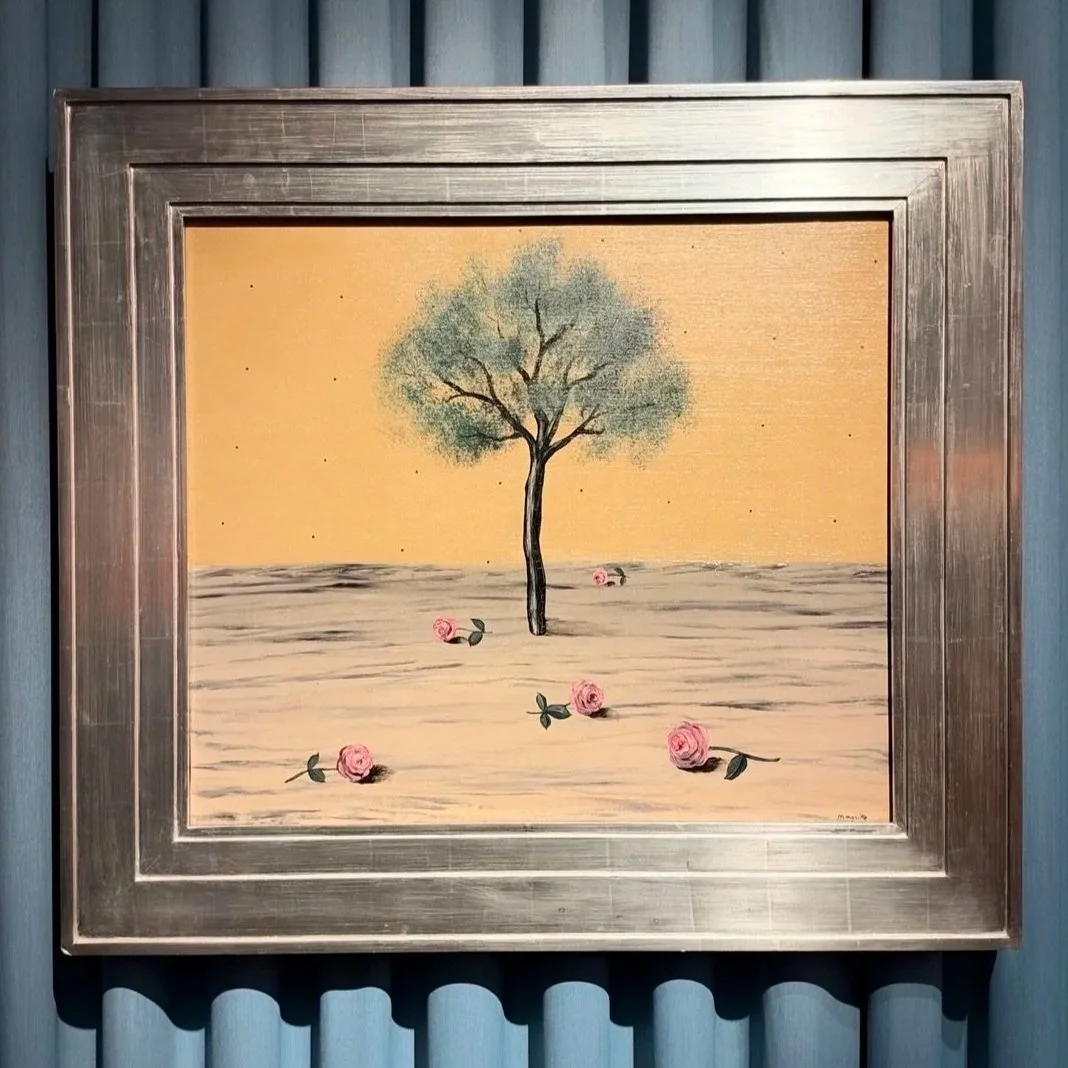
The Gagosian exhibition brings together some of the most iconic of Magritte’s paintings, such as “The Flowers of the Journey” (1926), which was featured in his first solo exhibition; “The Celestial Shade” (1927), which turned the sky into a physical body; or “The Interpretation of Dreams” (1935), which subverted the human understanding of reality. These and other less famous paintings evoke a phantasmagoric sense of encountering something completely ordinary, yet something which disturbs the familiar perception of reality. You are left confused, mesmerised, and troubled. Take “The Flowers of the Journey”, for example; the scattered roses seem perfectly beautiful in their serene stillness, yet the desert-like sky and snow-covered ground threaten with menace.
Some contemporary artworks are immediately recognisable as inspired by Magritte’s surrealist philosophy. For example, David Hammons’ satirical painting “Untitled” (1992) mocks the viewer by creating an image of the window dotted with flies by using wire mesh and zipper sliders (flies). Others draw more from the artist’s flattened perspectives and distinctive counters, as Sean Landers does in “All Quotes” (2025). In some pieces, the connection is not that apparent at all, yet the topic of influence is so interesting because it is so subjective – what appears entirely disconnected to some may bear solid parallels for the other.
Ultimately, no firm, universal interpretation of Magritte’s idea exists, for even he said about his paintings: “It does not mean anything, because mystery means nothing either; it is unknowable”.