
World Cup Groups are Drawn: What's in Store for Viewers This Summer
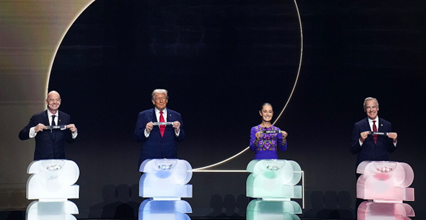
Image Credit: US Department of State via Wikimedia Commons
The world’s biggest football stage is set. With the 2026 FIFA World Cup draw complete, fans from Boston to Barcelona are preparing for a summer of spectacular clashes, historic debuts, and storylines that could define a generation. Hosted jointly by the United States, Canada, and Mexico, this edition promises new formats, cultural twists, and drama both on and off the pitch.
A New Era: 48 Teams, 104 Matches
For the first time, the World Cup will feature 48 teams, divided into 12 groups of four. The pots were seeded using FIFA’s November rankings, with the three hosts automatically placed in Pot 1 alongside the world’s top nine nations. This expanded format means 104 matches spread across 16 venues in North America, running from June 11 to June 19.
The traditional ‘Group of Death’ may be a thing of the past. With more teams and a more forgiving knockout structure, even the toughest group - Group 1: featuring France, Norway, and Senegal ranks only as the 32nd hardest in World Cup history.
Big Clashes and Early Storylines
The draw itself was a star-studded spectacle at Washington’s Kennedy Center, with celebrities from Kevin Hart to Tom Brady taking part. Argentina, defending champions, open against Algeria in Group J, while France face Senegal, and England meet Croatia in headline clashes. Mexico will kick off the tournament at the iconic Estadio Azteca against South Africa.
But it’s not just the established powerhouses drawing attention - first-time participants like Cape Verde, Curaçao, Jordan, and Uzbekistan promise fresh twists in the group stages. Pot 4’s mix of minnows and former heavyweights like Italy means surprises are almost guaranteed.
Why This World Cup Feels Different
The World Cup is more than a sporting event - it’s a global spectacle. Billions tune in, and entire nations pause daily life to watch the drama unfold. But staging the tournament in North America adds a new dimension.
Unlike football-mad nations in Europe or South America, the US treats major events as entertainment spectacles. Stadiums like MetLife and the renovated Azteca may host football, but with inclusion of halftime shows and fan zones, it might just feel like a gridiron spectacle in disguise.
Fans will also face challenges: ticket prices have been criticised as “record high”, ranging from £45 to nearly £6,000, while visa rules - including requirements to disclose social media history have raised concerns.
Evening kick-offs in North America will create late nights or early mornings for European viewers, forcing pubs to open at odd hours. For many, this will be the hardest World Cup to attend in person since Korea/Japan in 2002, given distance and expensive travel.
England’s Path
England starts in Texas before heading to Boston and New York. If they top their group, they’ll remain largely in the eastern region, playing in Atlanta, Miami, Mexico City, and potentially the final at MetLife Stadium.
Under new manager Thomas Tuchel, the Three Lions boast depth and versatility. Kane, Saka, and Rashford spearhead the attack, while Bellingham, Rice, and Palmer dominate midfield. Tuchel has emphasised squad balance, selecting defenders capable of covering multiple positions. History, however, warns of heat-related struggles, which England faltered in Qatar 2022, Brazil 2014, and S Korea/Japan 2002.
Legends and Last Dances
This summer may mark the final World Cup for Lionel Messi, Cristiano Ronaldo and Neymar Jr.
Messi has hinted he’ll only play if fit, potentially becoming the first man to appear in six World Cups. Ronaldo, now 40, has confirmed 2026 will be his last, still chasing the elusive trophy. Neymar, soon recovering from knee surgery with ‘Dr Miracle’ Eduardo Santos, has called the tournament his “last mission”.
Rising Stars
At the same time, a new generation is ready to shine. Spain’s 18 year old Lamine Yamal, already a Ballon d’Or contender, could become a global superstar. Norway’s Erling Haaland, absent in 2022, is set for his World Cup debut. Brazil’s Vinícius Jr. carries the hopes of a nation desperate to end a 24 year drought. England’s Cole Palmer, alongside Bellingham, brings youthful energy to Tuchel’s squad.
Favourites and What to Watch For
Spain, Argentina, France and England are the consensus favourites. Brazil remains unpredictable, and Portugal’s hopes hinge on Ronaldo’s farewell. Beyond football, FIFA has introduced mandatory cooling breaks at the 22-minute mark to protect players in the summer heat. Fans can expect cultural contrasts - from Mexican stadium traditions to US watch parties, making this World Cup a unique blend of sport and spectacle.
Comparisons to past tournaments are inevitable. The 2022 edition gave us Messi’s crowning moment and Morocco’s fairytale run. This time, the expanded format, North American setting, and generational crossroads, promise a summer where every kick, save, and goal could make history.
With legends bidding farewell and rising stars ready to shine, one question remains: which stories will live forever in World Cup history?