
Wuthering Heights: Why Can No Adaptation Do Brontë Justice?
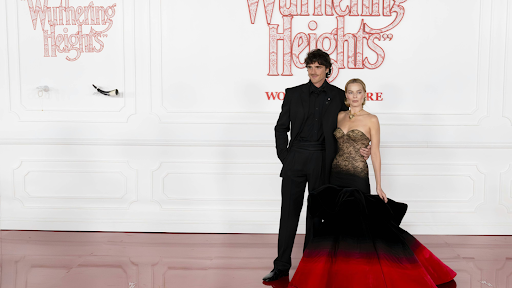
Image Credit: IMAGO/ZUMA Press Wire
I like to think Emily Brontë and I share a particular kinship: whatever our souls are made of, hers and mine are the same. I was 11 when I first opened Wuthering Heights, and that storm-soaked world marked the beginning of my love affair with literature – a love that carried me to a UCL English degree, where Cathy and Heathcliff still occupy a windswept corner of my imagination a decade later. You never forget your first love.
Emerald Fennell, then, had formidable boots to fill. I’m not a total purist; bold reinterpretations can work, but marketing a novel steeped in revenge and generational trauma as “the greatest love story of all time” betrays a profound misreading of the book’s jagged heart.
Fennell’s film plays less like an adaptation than fan fiction: Brontë’s savage meditation on inheritance, obsession, and social exclusion is streamlined into gratuitous, erotic romance. Heathcliff’s racial ambiguity underpins his outsider status and the brutality he suffers. Casting Jacob Elordi erases that racial discourse, reducing him to a brooding heartthrob (with a gold tooth and dodgy Yorkshire accent). Margot Robbie, meanwhile, transforms Brontë’s wild Yorkshire lass into Gothic Posh Brat Barbie. And while the novel’s power lies massively in the absence of sexual consummation, here Fennell has them popping off for multiple carnal encounters in moors, stables, carriages – more Bridgerton than Brontë.
The casting disregards the novel’s insistence that Catherine and Heathcliff resemble one another: dark, elfin, sibling-like. That uncanny likeness makes their quasi-incestuous bond unsettling as much as romantic: two halves of the same feral spirit. Robbie and Elordi, charismatic as they are, appear to inhabit a different film – one about thwarted passion between glamorous thirty-somethings, rather than a brutal psychodrama.
Fennell’s aesthetic signature is unmistakable. As in Promising Young Woman and Saltburn, the visuals are lush, the eroticism heightened, the mood decadent. The Linton honeymoon sequence involving a Glinda-esque cellophane negligee feels engineered for viral clicks rather than characterisation. Brontë’s mud-and-blood ferocity is repackaged as glossy, plastic provocation – with more red rooms than Jane Eyre. As with Saltburn’s loose invocation of Brideshead Revisited, the literary scaffolding feels aesthetic rather than structural.
By smoothing the novel’s rough edges and centring on the romance, the adaptation sacrifices what makes Wuthering Heights endure: its strangeness. Not faux Vermeer interiors or freckled skin wallpaper strangeness, but wild, Gothic instability. Brontë’s world is inhospitable and spiritually violent; Fennell’s is seductive and drenched in expensive-looking melancholy. The result is occasionally compelling, but untethered from its source – a passionate remix rather than a faithful haunting.
Perhaps this failure is inevitable. Wuthering Heights has long resisted cinematic translation. Brontë’s novel is extraordinarily dense and psychologically intricate; its emotional landscape feels uncannily real, yet fundamentally uncontainable. Heathcliff is less a man than an elemental force – one we recognize as if from dreams (or nightmares) – while Cathy is rendered with such interior intimacy that she seems to collapse into the reader’s own consciousness.
Whether an adaptation cleaves faithfully to the text or overlays it with Charli XCX synth pop (which, I’ll admit, wasn’t as jarring as I’d anticipated), something essential evades the camera. The novel’s ferocity resides not merely in its plot, but in its narrative architecture. The camera can capture moors and kisses, but not the wrenching force of Cathy’s “I am Heathcliff”– nor the abyss that answers it.
By erasing half the novel and flattening the characters whom it retains (a moment of silence for Isabella Linton, please), the film feels like capitulation. Rather than wrestle with Brontë’s vast, unruly design, it sidesteps it. If diminishment is unavoidable, I almost wish Fennell had relinquished the title altogether. What stands on screen is not so much Wuthering Heights as a departure from it: a steamy, stylish, BDSM-filled romance that begs for a new name of its own.
If all adaptations perished, and the novel remained, I should still continue to be. Brontë’s storm still rages on the page. The screen, for all its gloss (and cellophane), cannot quite summon that wind. When Heathcliff begged Cathy to “take any form”, he was not, I suspect, imagining cinema.