
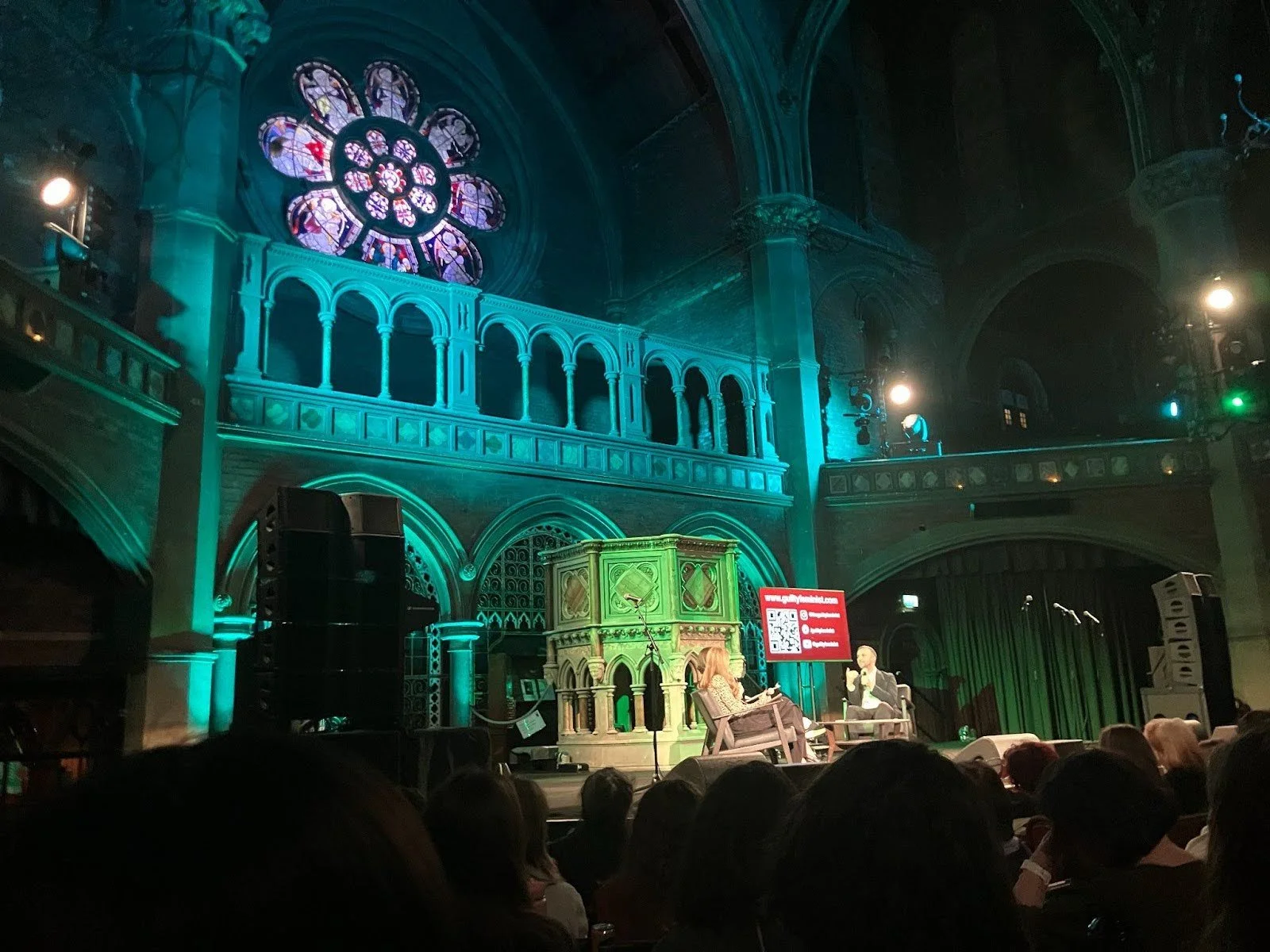
Image Credit: Jemima Corcoran
The softly illuminated façade of Islington’s Union Chapel felt almost incongruous with the gathering taking place within last Thursday. The church’s vaulted ceilings, stained-glass masterpieces, and theatrical lighting suggested something faintly ecclesiastical in the old sense of spectacle; I half expected a child dressed as the Angel Gabriel to descend from the rafters, perhaps crooning an Elvis number like in a particular Christmas comfort movie. Instead, we took to our seats accompanied by a soundtrack of white girl pop (Selena Gomez, Chappell Roan, Shania Twain). They certainly knew their audience.
The occasion was a live recording of the feminist comedy podcast The Guilty Feminist, hosted by comedian/author Deborah Frances-White, with co-host Juno Dawson, and guest panellist Zack Polanski. The evening promised an unusual hybrid: part cabaret show, part political rally, part collective therapy session for a generation increasingly anxious about the state of public life.
As a young woman in London, it’s very rare that I feel entirely at ease in public spaces - particularly on the streets after dark. Yet, standing in a queue of Green-aligned feminists outside the church, I found myself reflecting on the phrase “the woke brigade”, so often deployed as a pejorative in contemporary political discourse. I thought, if the people surrounding me constitute that supposed brigade, I truly wouldn’t want to be anywhere else.
The foyer buzzed with conversation as volunteers from MSI Reproductive Choices handed out free stickers, pins and information about reproductive healthcare and abortion rights. The atmosphere was earnest yet buoyant, as though everyone present shared an unspoken understanding: the world is not in a particularly good place, but we can still laugh together whilst attempting to change it.
Before the event formally began, I caught a glimpse of Polanski through a gap in the curtains. He was chatting fervently with someone backstage, smiling easily. There was something undeniably human about him: an effortlessness that lacked any trace of political stiffness or pretension.
The evening opened in the podcast’s customary fashion: the ritualised confession, “I’m a feminist, but…”
Polanski’s contribution was delivered with theatrical timing: “I’m a feminist, but… I’ve never slept with a woman… yet.”
The room erupted - hoots, cheers, stamping feet. It was exactly the note the evening required: irreverent, playful, and disarmingly candid.
Frances-White wasted little time turning to politics. She celebrated the Green Party’s recent by-election victory in Gorton and Denton, whilst cautioning the audience about complacency. “I really feel like things are shifting,” she said, though her tone suggested cautious optimism rather than triumphalism. That tension, the tension between humour and urgency, would come to define the evening.
Commanding the stage with the ease of a preacher rallying a congregation, Frances-White described Polanski as a rare politician who understands that politics is fundamentally about “leadership, not power.” An important distinction in today’s climate of narcissistic campaigning.
When the conversation segment (playfully referred to as ‘Act Two’) began, Polanski leaned into that very theme. His route into politics, he explained, began not in party headquarters but in the theatre. Influenced by Brazilian practitioner Augusto Boal’s Theatre of the Oppressed, he worked in community arts spaces, exploring how people might “rehearse revolution” by using storytelling and performance to imagine confronting injustice before encountering it in the real world.
“Enjoy the show,” he told the audience. “But remember, it’s not just a show. It’s people’s lives.”
Participation, he argued repeatedly, was the essential ingredient of democratic life. Whether through writing, singing, organising, or simply talking with neighbours, everyone has some role to play in shaping the society they inhabit.
Polanski’s willingness to address awkward questions also set him apart from your typical party leader. Asked about an infamous tabloid story from his past – an ill-judged body-confidence “experiment” involving hypnosis – he was strikingly candid: “I hadn’t learned how to say no yet,” he admitted. “It doesn’t represent me, and it’s not something I’d do today.”
The discussion ranged widely: drug regulation, proportional representation, wealth taxation, arts funding, and the rise of online misogyny within the so-called manosphere. One statistic landed with particular force: in the United Kingdom, a woman is killed roughly every three days.
“None of that is normal,” Polanski said. “And none of that should be normal.”
Yet despite the gravity of such subjects, the evening retained an unmistakable warmth. During the interval, Polanski wandered through the aisles chatting with attendees, posing for selfies, shaking hands, and hugging supporters with the relaxed familiarity of someone who genuinely enjoys meeting people.
“Safe spaces” have become an easy target in political commentary – shorthand for fragility or ideological retreat. Yet standing in that church, surrounded by laughter, activism, and a stubborn strain of optimism, the phrase acquired a different meaning.
While contemporary politics often feels bleak, this gathering offered a fleeting glimpse of an alternative: a community convinced that change remains possible, and determined to sing, laugh, and shout about it until it arrives.