
Image Credits: Larina Fernandes via Tate Britain Press Office
The James McNeill Whistler collection debuted to the press at Tate Britain on Tuesday, in what is set to be the largest European display of his work in at least three decades.
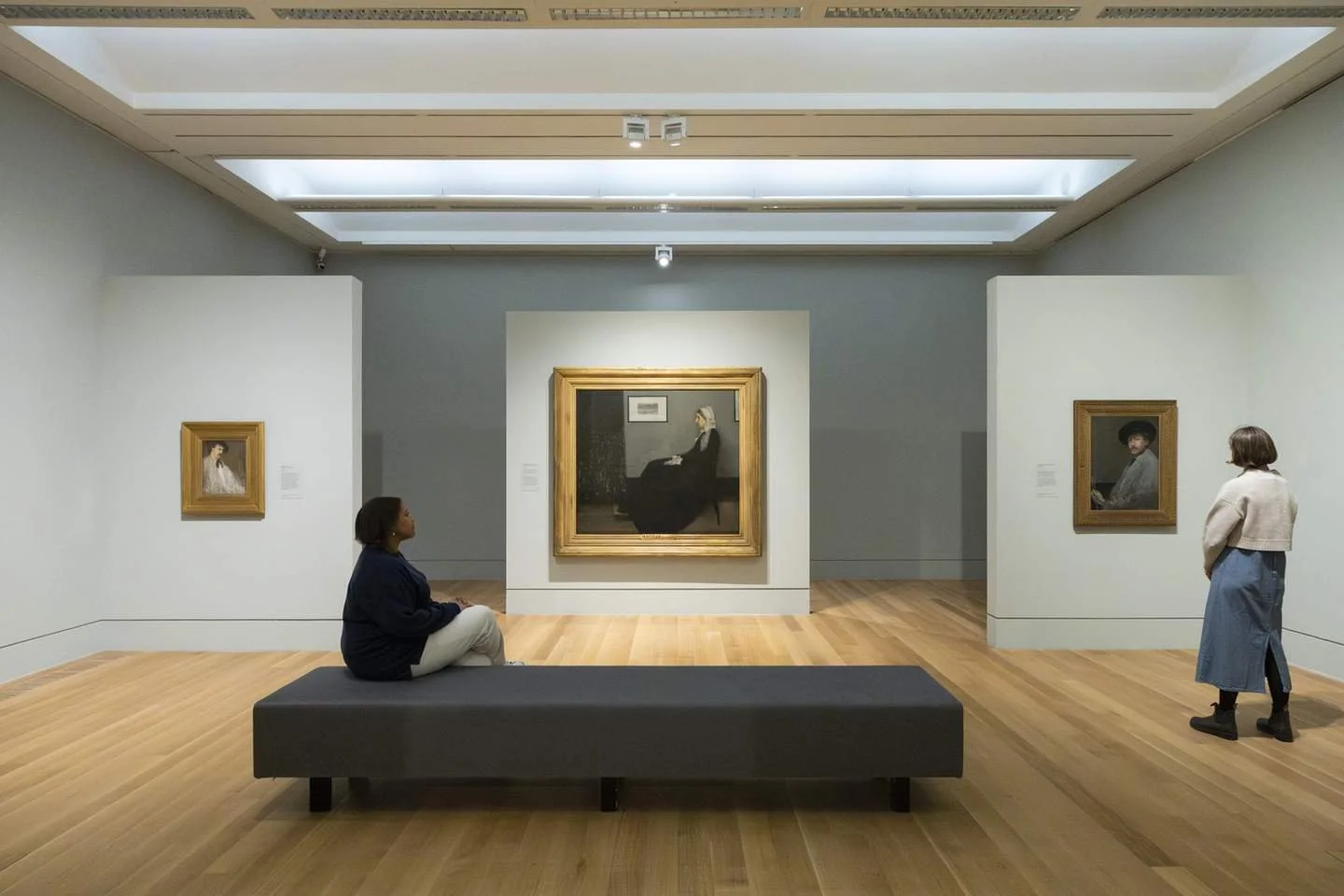
Accompanied by Carol Jacobi, the curator of this expansive exhibition, we were privy to the interiors of the Tate Britain modelled after Whistler's own artistic visions. The plain painted walls offered up an effective backdrop for the portrayals of Whistler’s restless soul, which produced the works that challenged contemporary artistic conventions and demonstrated his experimentation with abstraction.
Works from Whistler’s teenage years have been displayed (many for the first time) as well as pieces from select private collections, and the White House. Through the chronological configuration of the gallery, we see the often mercurial nature of Whistler’s artistic journey, as the gallery’s walls transition from oils to etchings, and from the Aesthetic to the abstract.
In the gallery’s second room hangs the pen-and-watercolour work ‘Scene from Bohemian Life’, in which his early Romantic influences (in this case, Murger's novel of the same name) are evident. Whistler’s transition from line to colour can be seen first in his own self-portrait in the late 1840s and then in his early career in Paris, where recent conservation efforts saw the dating of the oil ‘Head of a Peasant Woman’ as the earliest surviving painting from his years in Paris. Another oil painting from Whistler’s Parisian days, ‘La Mère Gérard’, depicts an unnamed Parisian street-seller, the brushstrokes evocative of earlier 17th-century masters such as Rembrandt.
The exhibition paid particular attention to the Japanese influences on Whistler’s art, featuring the artwork of Japanese artists who inspired Whistler, such as Hiroshige, as well as pieces from the British Museum. This seamless integration of contemporary influences helped to contextualise Whistler’s wider body of work.
Spanning three continents, the gallery showcases the global reach of Whistler’s work and the wide variety of mediums and styles he experimented with, demonstrating an underlying theme of challenging nature. Featuring a published transcript of Whistler’s Ten O’Clock lecture in Piccadilly, his declaration that nature is “rarely right” shines through his body of work, with the display of Whistler’s ‘Nocturne’ series culminating as the most haunting demonstration of his abstraction of London’s landscapes, depicting river scenes as smudges of dark and light.
A disruptor in every sense of the word, the exhibition puts the contentious nature of Whistler’s life and work on full display – whether that be his occasionally intimate relationships with his subjects in Paris, his pastels of Venice’s backstreets, or the increasing abstraction of his brushstrokes in his maritime paintings. Whistler’s bold style could somehow only be described as Modernist in its technique, before the moment even came into existence.
The exhibition is what I can only describe as a post-mortem of Whistler’s psyche, from the external influences of 17th-century European portraiture and contemporary avant-garde artists, to (from what we can see of his early art) a desire to disturb nature from within. The largest European showcase of his work in three decades, it offers a lens through which Whistler’s oeuvre has rarely been seen before.
The Tate has put on a display of Whistler’s work that is a blueprint for the understanding of the depth and elemental complexity of an artist so often caricatured, and who often pushed the boundaries too far. The Tate Britain offers a comprehensive education of his body of work, and an autopsy into his soul.
The James McNeill Whistler exhibition is free to Tate members and is open at Tate Britain until 27 September 2026. Tickets are available to book here.