
China’s ‘Artificial Sun’ That Could Change The Future of Energy
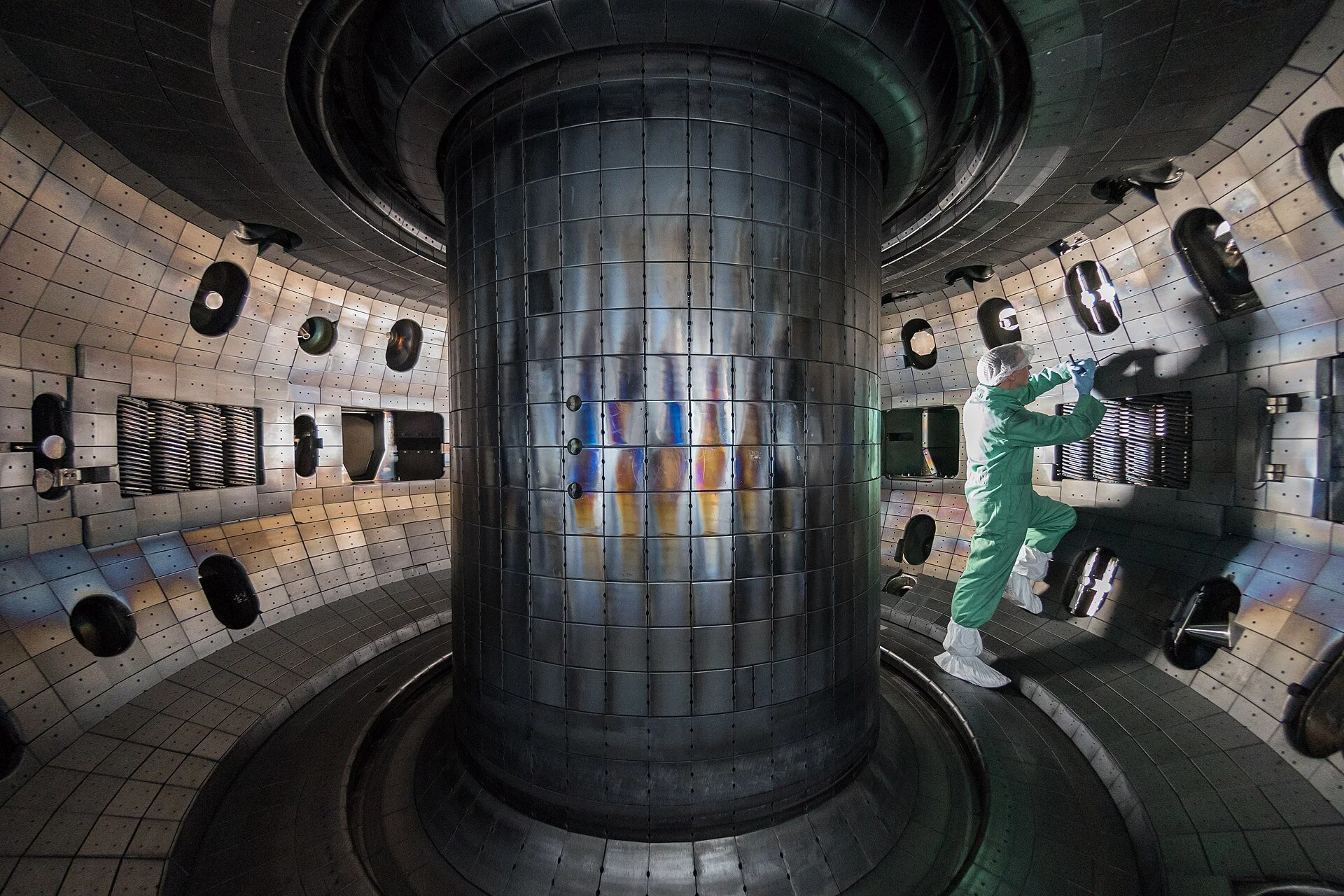
Image Credit: Rswilcox via Wikimedia
Calling all surviving victims of GCSE physics, I formally challenge you to recall the difference between nuclear fusion and fission; can you remember either at all? Well today is your lucky day, because only one will be relevant to this article, so for now you are off the hook…
A report published on January 1st of this year revealed that astronomical developments have been made in nuclear energy research in the form of China’s fusion device, the Experimental Advanced Superconducting Tokamak (EAST), commonly referred to as their very own artificial sun.
Nuclear fusion involves the joining of two light nuclei into one heavy nucleus, the same process which occurs in the formation and powering of stars. A tokamak is the machine scientists have been experimenting with in an attempt to mimic this stellar reaction. An international endeavour, countries all over the world have been striving to harness nuclear energy. See Japan’s JT-60 machine, the Joint European Torus (JET), USA’s Tokamak Fusion Test Reactor (TFTR), etc. (It is one hundred percent a fact that the seriousness of the field is directly proportional to the number of abbreviations that no one can remember).
However, despite huge progress being made globally, the hope to see practical usage of nuclear energy via fusion has been viewed as a bit of a wish-upon-a-star. A key universal problem arises in the stable confinement of plasma, the state of matter in which hydrogen isotopes must be maintained to carry out fusion. High plasma density helps fusion reach ignition, but tokamaks face a density ceiling called the Greenwald limit. Exceeding this empirical limit was generally thought to promise disruption (where the plasma becomes suddenly very unstable), which poses serious risks of damage to the tokamak, and results in a significant plummet in performance.
In the report mentioned previously, it was revealed that the research had proved a theoretical density-free regime; through changing certain start-up conditions, the density limit can be exceeded. in the experiment, the Greenwald limit had been surpassed by 1.3 to up to 1.65 times, going far beyond what was thought possible. Thus, China’s artificial sun shone a very real light on “a promising path toward achieving the fusion ignition condition.”
Clean power, more jobs, and increased national security are all advantages associated with nuclear energy, which was officially stamped with a green label by the European Commission in 2022. On the other hand, despite major breakthroughs, some think that progress in this field has been too incremental, and money would be better invested in projects viewed as more realistic. Not to mention public anxiety surrounding the very word ‘nuclear’. The debate has drawn in prominent voices: Sam Altman, the CEO of OpenAI, has reportedly invested millions of dollars in nuclear energy, believing it will eventually be the only means of fuelling ever-growing advancements in artificial intelligence.
“Nuclear fusion is thirty years away and always will be” is a common joke amongst physics-enthusiasts. Will the idea of practical success in nuclear fusion be abandoned to the past, or remain trapped in a future perpetually unreachable? Or, as perhaps recent developments suggest, the sun is rising in the EAST.