
Image Credit: Alamy
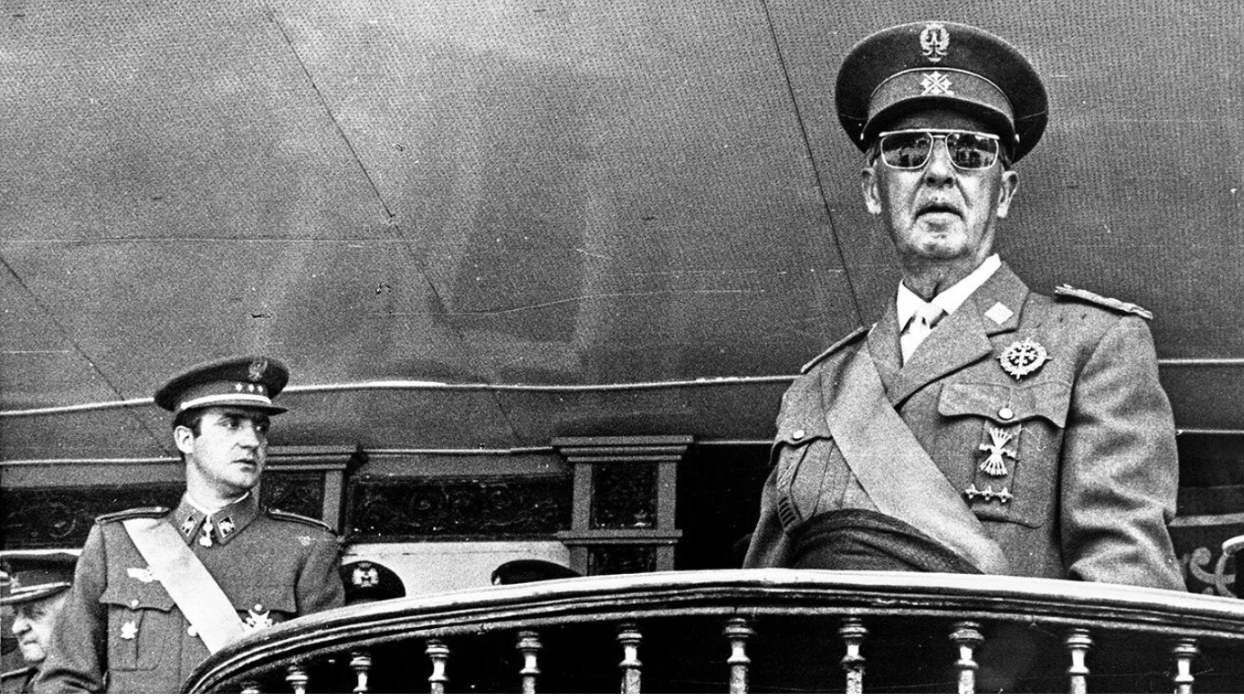
On the 20th of November 1975, Francisco Franco took his last breath, ending an ironclad dictatorship that had entrapped Spain since 1939. Fifty years on, his legacy still haunts the country’s people, but the horrors of his regime are starting to fade. A recent survey revealed that over 20% of Spanish adults view Franco’s dictatorship positively. As a frightening wave of nostalgia for the Caudillo emerges amongst some of its youth, Spain must confront a pressing question: how can a nation’s cultural landscape move forward when it cannot reckon with its past?
In 1936, Franco began his nationalist rebellion, which led to the start of a brutal civil war. After almost three years of Nazi-aided attacks, the republicans finally surrendered, and Franco began his reign of terror. Despite Spain having been a consolidated constitutional democracy since 1978, Francoism is creeping back into the youthful mainstream: the aforementioned survey by the Centro de Investigaciones Sociales (CIS) also found that 14.4% of 18-24-year-olds see their current democratic system as inferior to Franco’s regime. Though still a minority, this surge is unprecedented and disproportionately concentrated among young adults.
This shift is fuelled by a potent combination of radical social media narratives and newly established far-right movements: parties such as Vox, of which 29% of its voters are aged 18-24, do not outrightly idolise Franco but fuel this misinformed nostalgia through their dominant social media presence. Javier Lorente, an expert in political science, suggests that ‘Social networks are whitewashing the authoritarian past through decontextualised narratives’ , resulting in memes and other content that trivialise Franco’s authoritarian rule. The Spanish government has, however, attempted to counteract such glorification of the dictator; it controversially relocated his corpse from the Valley of the Fallen to a private plot in 2019, which Prime Minister Pedro Sánchez hailed as a ‘great victory for Spanish democracy.’ Nonetheless, these efforts may be insufficient.
Franco’s newfound cultural resonance is further strengthened by its link to the online ‘manosphere’. His regime was characterised by a culture of machismo in which male dominance was established through policy: women required permiso marital to open bank accounts, work, or drive; democratic suffrage for women was abolished; and there were lenient penalties for husbands who killed their adulterous wives. In an age when misogyny and incel culture are rife, some young men seem drawn to these so-called ‘traditional’ values. This ideological manspreading is not solely confined to Spain: as 52% of surveyed Britons aged 13-27 supported establishing a British dictatorship, 45% of male respondents also said the promotion of women’s equality was ‘discriminating against me.’
Alongside this conflation of far-right extremism and misogyny, a worrying trend of ‘casual fascism’ - where this extremist ideal is treated with concerning lightness - is emerging online: consider the viral Jubilee clip of a man laughing as he calls himself a fascist, only to blame his consequent firing on ‘cancel culture.’ An alarming reality is emerging: Fascism is becoming increasingly appealing as the all-in-one antidote to political discontent, reflecting a dangerously shallow understanding of its past.
After encouraging starving Spaniards to grow food on privately owned land, my great-great-grandfather, Emiliano Hidalgo, was declared an enemy of Franco’s regime; he was executed without trial in Dos Torres, Córdoba, in 1937. His wife and daughter were publicly humiliated with head-shaving, and his sons were sent to concentration camps. Millions of families, including mine, were traumatised by the horrors of the civil war and dictatorship. Amid the misinformation circling among some Spanish youth, my grandmother Ana Maria says: ‘Though we can’t change the past, we must keep history alive and be reminded of this tragedy, or I fear it could happen again.’