
Pizza or Petrie? The Controversial Pizza Shop Underneath UCL’s Petrie Museum
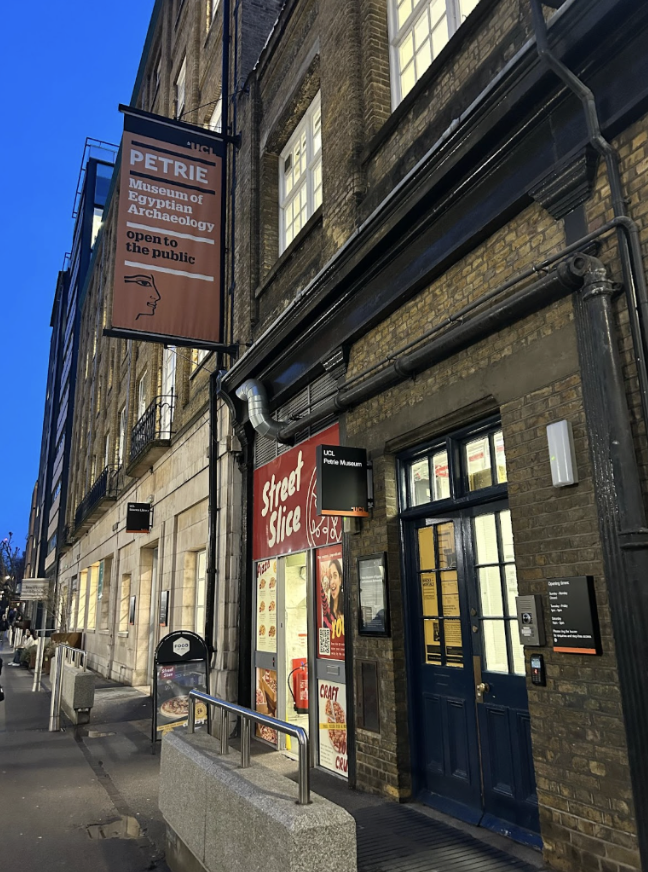
Image Credit: Charlotte Berman
UCL is home to three accredited museums, including The Petrie Museum of Egyptian and Sudanese Archaeology. The Petrie holds a vast ancient collection, including the oldest known, most complete woven garment, and numerous pieces of organic material. The museum is free for the public to enter, and as a Museum Studies student, I spend a lot of my time engaging with material in the museum.
Through discussions with past and present staff and independent research linked to lecture material, I have come to learn about an establishment popular with many UCL students, Street Slice. Having opened around 10 years ago (under different owners), the pizza shop provides students with cheap hot food in the heart of campus. However, the takeaway’s location underneath the Petrie Museum is controversial for various reasons.
Pests
Firstly, food attracts pests, which can have a devastating impact on museum collections. Pests, ranging from rats and mice, to beetles and moths, can eat through material, leave excrement on objects, or lay eggs, creating holes or stains which permanently damage objects. IPM (Integrated Pest Management) is used by museums to monitor pest activity, which is especially helpful for museums that have cafes, however as Street Slice operates entirely separately from the Petrie, few measures can be put in place to prevent pest activity.
Pollutants
Air pollutants from the pizza oven’s chimney can damage the museum collections. The pizza oven produces smoke and steam and therefore damaging particles travel through the air, which is the most significant risk to the Petrie collection. The late Graeme McArthur, UCL Museums Conservator, began investigating this issue in the Petrie, analysing the impact of the damage of the air pollutants produced by the pizza oven on the collection held. However, the results of his investigation are yet to be concluded and published.
Temperature
Last but not least, the heat generated from the pizza oven causes damage to the Petrie’s collection. The optimal temperature for museum exhibition spaces is 16-20 degrees Celsius, and having an industrial pizza oven underneath the museum has disrupted this immensely. In a hot environment, pest and biological growth is encouraged, and objects can deteriorate by expanding or shrinking. High temperatures lead to increased humidity, which can also cause objects to deteriorate if relative humidity (RH) is not kept between 40 to 70%.
Furthermore, the pizza oven has the potential to have devastating effects on the collection. In February 2025, The Chiltern Firehouse was partially destroyed by a fire, which was caused “by burning wood falling from a pizza oven”. This shows how destructive fires caused by pizza ovens can be, and poses a huge risk to the collection at the Petrie Museum. I spoke with Dr Anna Garnett, Curator of the Petrie, about the dangers of having a pizza oven underneath the museum:
“The Petrie Museum’s collection is internationally important and includes a unique assemblage of thousands of very fragile, ancient organic objects. As curator of this collection, knowing that these precious textiles, baskets, sandals and wooden objects currently sit above a large pizza oven is a cause for concern.”
Just under 75 years ago, The Petrie was relocated into a temporary location, an old stable house in Malet Place with low ceilings and a lack of storage space. To this day, this continues to be the museum’s location which does not meet the museum’s needs. Narrow corridors and cramped storage solutions mean curators, conservators and researchers cannot easily access objects, which directly harms the museum’s primary use as a teaching collection.
In October 2025, Petrie Curator Anna Garnett, and Head of Collection Catriona Wilson, were the first guests invited to speak on the Faces of UCL podcast, hosted by Provost Michael Spence, where he commented ‘It’s [The Petrie Museum] so you see one of the world’s best collections above a pizza shop’. This highlights a key point, as the Petrie holds over 80,000 objects, making it one of the largest Egyptian collections outside of Egypt itself, yet its location above a pizza shop indicates that it is undervalued by UCL.
Speaking to Dr Alice Stevenson, UCL Professor of Museum Archaeology, and Curator of the Petrie Museum from 2012-2017, she expressed her dismay at the implementation of a pizza shop underneath the museum during her time as curator, emphasising that “UCL did not consult with any member of staff working at the museum”. This means that experts in curation and collections management were unable to explain the detrimental effects of placing a pizza oven underneath the collection. As no member of staff was informed that a pizza shop was going to be set up underneath the museum, disaster management protocols had to be urgently, and retroactively fitted to cover the new dangers a pizza oven posed to the collection.
The placing of a pizza shop underneath the Petrie Museum is extremely controversial, and poses a multitude of risks to the safety of the museum’s collection. Although the shop provides students with low cost, hot food in the heart of campus, the oven that lies directly underneath the collection poses a serious threat to the preservation of historic objects, and continues to concern museum and academic staff, and students alike.