
The Lie of the Colour Revolution
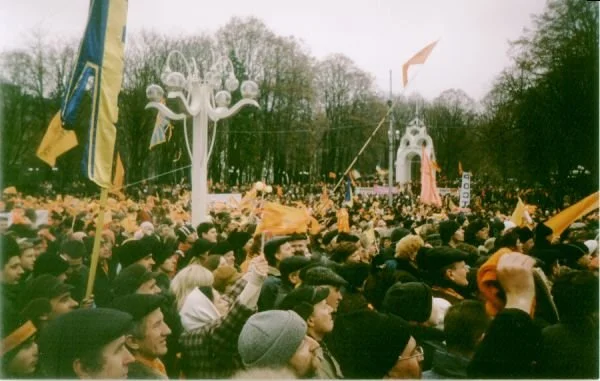
Image Credit: Anstan07 via Wikimedia
Last week I was at my local gym in Marylebone, and I started chatting with two men: one was older, white, and conservative, the other was young, left-wing, and South Asian. As one would probably expect, they disagreed on topics ranging from immigration to the cost of living crisis. However, once we started talking about the popular protests and uprisings in Iran and in Minneapolis, they agreed on the same narrative - that Revolutions are fabricated by foreign spies to engineer the wishes of a sinister superpower.
After some research, I discovered that this conspiracy theory is so widespread it has a name: The Colour Revolution. Popular with both sides of the political spectrum, from John Mearsheimer to Joe Rogan, this idea began in the political and economic turmoil that followed the collapse of the Soviet Union. An American writer, F. William Engdahl, watched what was happening on TV and started writing about how George Soros , together with the Rothschilds and the CIA, financed a network of fake NGOs to indoctrinate locals and launch popular uprisings. The purpose of such a scheme was, allegedly, for the West to exploit and destroy the economies of ex-Soviet states. From that base, the Colour Revolution theory grew to explain the revolutions of the Arab Spring, Ukraine, today in Iran and even Minneapolis. It seems counterintuitive that such a flimsy, anti-semitic global conspiracy could catch on, but the Colour Revolution has proven strangely adaptable for different situations.
My gym interlocutors, like so many people, no matter their political beliefs, probably feel powerless in making themselves heard. They must assume that those taking to the street are powerless too. There is also an undeniable element of shame. I asked them if they had ever participated in a protest or signed a petition. They said there was no point. They had stopped believing in their democratic agency. This, then, explains why they would deny other people their powers of decision-making and instead think of them as puppets, manipulated by a deep state or a foreign agent.
A terrible consequence of this Colour Revolution is that it erases the real reasons people revolt, such as repression and the abuse of women in Iran, or ICE killing civilians with impunity in Minneapolis. We ended up talking, the three of us, for almost an hour, not about any of these facts, but about how secret agents from a mysterious country would plot and scheme to start an entire revolution. Such thinking distracts and shifts blame from the real perpetrators.
At some point, I had to ask, ‘But what about the reasons people take to the street? The real abuse and repression, the lack of opportunity? How can foreign bankers and spies provoke hundreds of thousands of people to risk their lives if they didn’t have real grievances? It's not like you can bribe or blackmail hundreds of thousands of people.’
They were unable to answer my question; they could only retreat back into the same unproven, sensationalist, and racist arguments, such as the CIA being omnipotent, Jewish bankers controlling every economy in the world, and the nebulous motivations of the ‘Deep State’. A rhetoric of sensationalism that is so vague that F. William Engdahl, during the pandemic, wrote after the George Floyd protests that the US government was trying to overthrow itself through a homegrown Colour Revolution.
Our conversation ended calmly, but like most political discussions, inconclusively. In the same way they didn’t convince me of the Colour Revolution, I didn’t change their point of view either. It’s a difficult conspiracy to root out because it allows people to escape the guilt of not taking ownership of their political lives.