
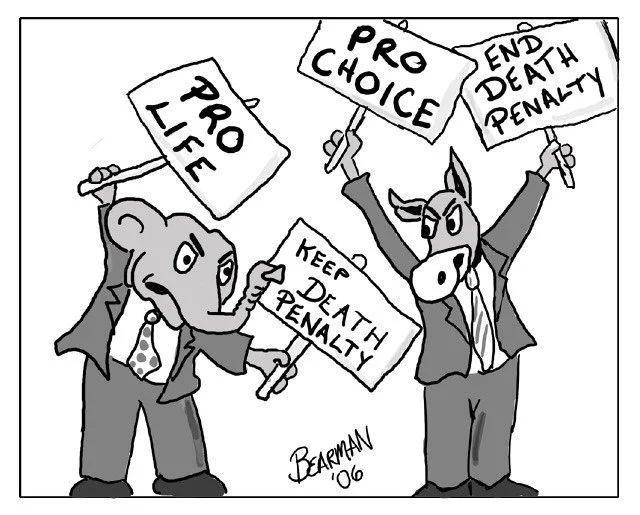
Image Credit via Flickr
Politics today increasingly operates within a black-and-white moral framework, in which positions are judged as wholly right or irredeemably wrong, and disagreement is often treated as evidence of personal failure rather than intellectual difference. This all-or-nothing worldview has come to dominate public discourse across social media, news cycles, and even everyday conversations, reshaping politics into a terrain of moral absolutism. While this framing can feel emotionally satisfying, offering clarity, certainty, and a sense of belonging, it ultimately undermines meaningful political dialogue and the democratic process itself.
At the heart of this shift is the growing tendency to collapse political disagreement into moral identity. Political views are not merely positions one holds; they are increasingly understood as reflections of who one is. To disagree, then, is not simply to contest an idea, but to challenge a person’s values, ethics, or legitimacy. This dynamic leaves little room for ambiguity or intellectual uncertainty. Nuance becomes suspect, compromise becomes betrayal, and asking questions is interpreted as moral weakness or bad faith. In such a climate, politics transforms from a collective effort to negotiate shared realities into a battleground defined by rigid moral binaries.
Social and digital media have significantly accelerated this process. Platforms reward content that provokes strong emotional responses, particularly anger and moral outrage, while quieter, more reflective contributions are often buried. Political theorist Cass Sunstein has shown that when people are primarily exposed to views that mirror their own, they tend to adopt more extreme versions of those views over time, a phenomenon he describes as “group polarization”. This helps explain why political discourse has become increasingly absolutist: communities reinforce their own moral certainty while caricaturing opposing views, making dialogue across difference ever more difficult.
What is lost in this black-and-white framing is the recognition that political problems are rarely simple, and almost never reducible to a single axis of right versus wrong. Issues such as immigration, climate policy, healthcare, or criminal justice involve competing values, material constraints, historical legacies, and unintended consequences. Treating these debates as moral litmus tests flattens their complexity and discourages the sustained, uncomfortable conversations that real solutions require. When politics is reduced to choosing sides, there is little incentive to engage with trade-offs, acknowledge uncertainty, or revise one’s position in response to evidence.
This moral absolutism also reshapes who feels able to participate in political discussion. Many people withdraw not because they lack convictions, but because they fear social punishment for expressing views that fall outside rigid ideological expectations. In this way, a black-and-white worldview paradoxically produces both hyper-engagement and silence: the loudest, most uncompromising voices dominate public debate, while those with mixed, evolving, or conditional views retreat from it. The result is a public sphere that becomes narrower rather than more inclusive, despite its apparent intensity.
Importantly, criticising moral binaries is not the same as rejecting moral judgment altogether. Some political issues do involve clear ethical stakes, particularly when fundamental rights, safety, or dignity are threatened. However, even in these cases, an insistence on absolute moral clarity can obscure the structural, economic, and historical forces that shape political conflict. Moral certainty may mobilise people quickly, but it rarely sustains the long-term, structural thinking required for meaningful change. When politics becomes a competition for moral superiority, understanding power, institutions, and material conditions often falls by the wayside.
A black-and-white worldview also weakens democratic accountability. When political actors are evaluated primarily on symbolic alignment with “the right side,” rather than on the outcomes of their policies, meaningful critique becomes difficult. Leaders can perform moral righteousness while avoiding responsibility for ineffective or harmful decisions, and failures are dismissed as unfortunate but necessary sacrifices in a moral struggle. In this sense, absolutist politics does not challenge power so much as it rebrands it.
Recovering a more nuanced political discourse does not require abandoning moral commitments; it requires rethinking how disagreement is understood. Disagreement should be recognised as an inevitable and productive feature of pluralistic societies, rather than as a moral threat. This involves cultivating intellectual humility—the recognition that political understanding is always partial and that no position is beyond critique. It also means creating spaces where complexity is not penalised, and where changing one’s mind is treated as growth rather than betrayal.
Democracy depends not on unanimity, but on the capacity to live with disagreement without collapsing it into hostility. A politics framed entirely in black and white may offer emotional clarity, but it does so at the expense of dialogue, trust, and collective problem-solving. If political discourse continues to reward absolutism over understanding, the greatest loss will not only be nuance or civility, but the democratic imagination itself.