
“Who Decides Who Belongs?”: In Conversation with Repatriated’s Sebastian Senior
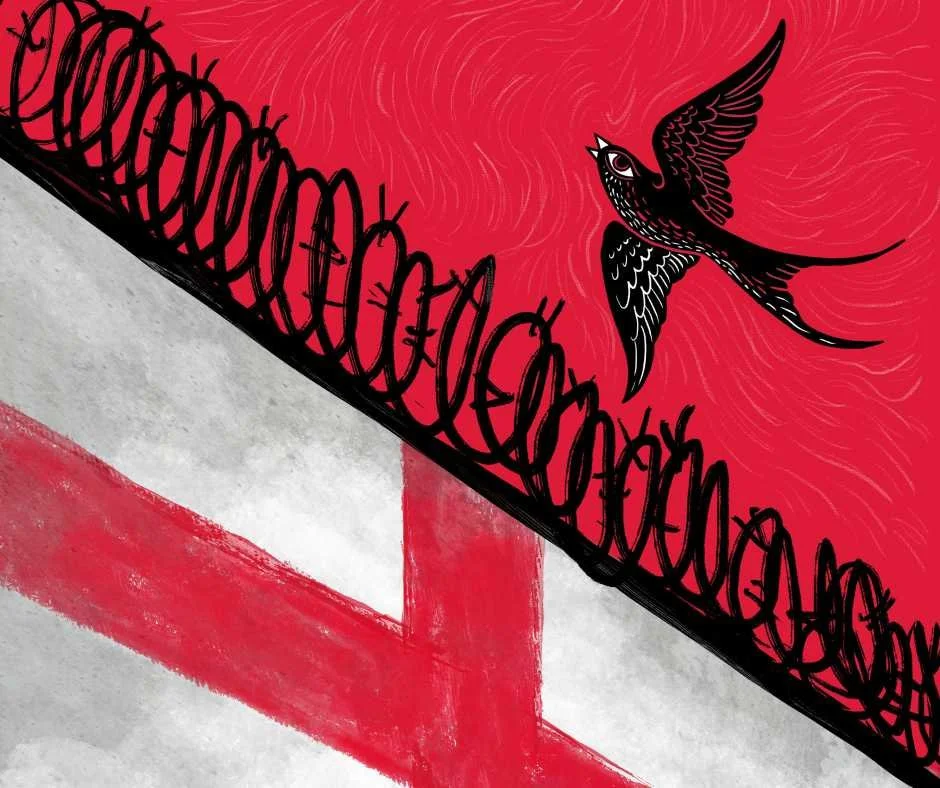
Image Credit: Ola Intu
Repatriated is a one-man theatre production that fuses film, sound, and immersive design, taking its audience into a dystopian Britain where it interrogates notions of identity, surveillance, and activism. I sat down with Sebastian Senior, the show’s writer, director, and lead actor, to find out more about what Repatriated means to him.
How would you describe Repatriated to someone unfamiliar with your work?
“It's a political thriller focused on a British-born filmmaker. He’s immersed in British culture, but he gets into a situation where he becomes aware that the people around him have a different perspective on what being British is, sending him down a metaphorical rabbit hole into a world of activism, police surveillance, resistance, AI technology, and serious government and technological infrastructure.”
How does Repatriated engage with contemporary ideas of British identity?
“It’s a story about belonging: who decides who belongs? It’s also about family – not just your biological family, but the support systems that you have in place around you.
Throughout Repatriated, we have certain British symbols that recur: the St. George's cross and Union Jack flags, British football, we have the Sex Pistols and punk music – a lot of things that people would traditionally associate with British culture, in a positive sense, but also in a sense that can be quite challenging. For example, does the culture sometimes exclude other people?”
How did you approach balancing personal narrative with broader political themes? Were there particular real-life testimonies or stories that influenced the characters?
“I was following the Shamima Begum case: she had her citizenship deprived after she joined ISIS. Up until recent days, the deprivation of citizenship has been used to remove citizenship from people who have either committed fraud in their papers, or who have been involved with serious terrorism activities. The idea within this play is, what if they broadened that spectrum to include someone who might have an ideological difference to the state? And, actually, the legal framework which we have in this country means that could genuinely happen: the threshold is that if someone’s not conducive to the public good, we can deprive them of their citizenship. And who decides that?
There was a situation a few years ago with the England footballers. It was a racism situation, where the three black guys missed the penalty and it created this big fanfare – that also inspired me.
There’s content in the show to do with the police and political protests, I've been following Palestine Action and the arrests that have been made.
There are also elements of the ‘Raise the Flag’ campaign from last year. The main character of Repatriated possibly would be more on the side, initially, of someone who would be putting up these flags, so we're seeing it from a different perspective.
It’s equally to do with surveillance technology. I've been looking into Palantir and their involvement in the ICE raids in America. I think that if we were to move towards fascism, it would take a more bureaucratic state than what happened in Germany.
Finally, the Freedom Cities – I used them as an inspiration for elements within the play. I wanted to look into, if you had a special economic zone, how that could be used to exploit people who had been made stateless, and to exploit labour rights and work conditions.
The characters have been inspired by a lot of different people. The main character came from some people that I know, some friends… the filmmaking element came from one of my best friends and some of the situations that he’s experienced as a filmmaker.
I also wanted to create this character modeled on some of the characters from the Spaghetti Westerns, especially the Clint Eastwood Man Without A Name trilogy – you have this main character who's an anti-hero, you don't necessarily know which side he's on and it's really morally ambiguous. I find that interesting because you can explore both sides of a debate or a conflict.”
How has the script evolved through rehearsals or collaboration?
“The first evolution was it had to be reduced quite significantly! I think I cut about 25% of it, which was difficult – I lost some of my favourite scenes! Although I enjoyed them, they didn't necessarily move along the story.
I’ve been working alongside a movement director called Atrix who I've worked with before – we actually went to university together, and they’re fantastic!
We’ve got a media designer and a graphic designer. Ola Intu, who's been doing the set designs and artwork, has created some incredible installations. Working with lots of different people spurs my creativity and helps to inspire me; it keeps me motivated – it's difficult when you're doing a one-person show and you have to motivate yourself all the time!”
What responsibilities do you think theatre-makers have when tackling politically sensitive topics?
“It's very important when tackling political subject matter to refrain from crass characterisations or stereotyping, especially when you're trying to depict people who might not operate in the same political spectrum as you. It's very easy to look at other people and think “you've got this idea, I don't agree with that, therefore you're a bad person.” So I wanted to create characters in the story who exist across the political spectrum. None are perfect, all have issues. I want to create less of an ‘us and them’ spectrum and focus more on the things that unify us – it's all based on human experiences.”
Are there any writers or performers who have particularly influenced your work?
“Definitely Shakespeare. It's the innovation of the language and the poetry of the words, which I think are incredible. He’s able to create something that’s both rhythmical and also tells a story. He kind of created a benchmark for how plays should be structured.
In terms of the modern day, I follow a lot of independent cinema. I really like Ruben Östlund. He came from a documentary-filmmaking tradition and channelled that into narrative storytelling. He uses a lot of innovation, and observation, and he lets the stories build almost organically. He gets these really naturalistic performances from his performers, and I find that very inspiring.”
As both a performer and writer, how do those roles inform each other in your work?
“Well, positive and… not negative, but definitely challenging! The positive thing is, because I've written it, I know what I mean and I understand what the characters are thinking. But it’s obviously a lot of work: writing, directing, acting.”
What are the biggest challenges of staging politically charged work live?
“You could get some people in the audience who are completely against the political framework or political vision that you're presenting, and they could react negatively towards it… I guess that could manifest in heckling, booing, or people walking out… But I think sometimes you should take that as, well, at least it had an impact! The important thing is to not go out looking to offend people, and I’m not looking to offend anyone. It all comes from a good place.”
And on the flip side, what are the most rewarding aspects of telling these stories in a theatre space?
“Definitely being able to have those conversations afterwards. I think sometimes with politics, people might get concerned about things that they see or experience, but are a little bit afraid to articulate it. That can be dangerous, whichever side of the political spectrum you’re on, because when these thoughts of being incapable of speaking about something start to marinade inside you, they can come out in a more destructive way. It's really important to keep on spurring the conversation, continuing the debate, and letting people think about things on a slightly deeper level.”
How has collaborating with other actors and creatives shaped this piece?
“It's been so fantastic. I mentioned Ola Intu, who's been doing all of the design and artwork. Denzel Hassell, who's a brilliant graphic designer, has been designing these brilliant corporate brand identities. Yohan Forbes, who’s a film director and a very close friend of mine, has been creating some filmed elements. Then, obviously, working alongside the old Brazen Hodgepodge gang! They're going to appear in some film segments that recur throughout the story. It's so entertaining to be around them, they're always making jokes and going off on random rants. We have a lot of fun, so I really enjoy working alongside them!”
If audiences could take away just one idea from Repatriated, what would you want it to be?
“Definitely self-determination: finding that belonging within yourself. A lot of the time, we want to fit in and we want to be part of a group. Community is very important, but it begins within yourself before you can find that with others.”
Repatriated will be performed at Canada Water Theatre, as part of Peckham Fringe, on 13th and 14th May. Tickets are available here.